10 Best Redbubble Alternatives in 2026 for POD & Online Selling
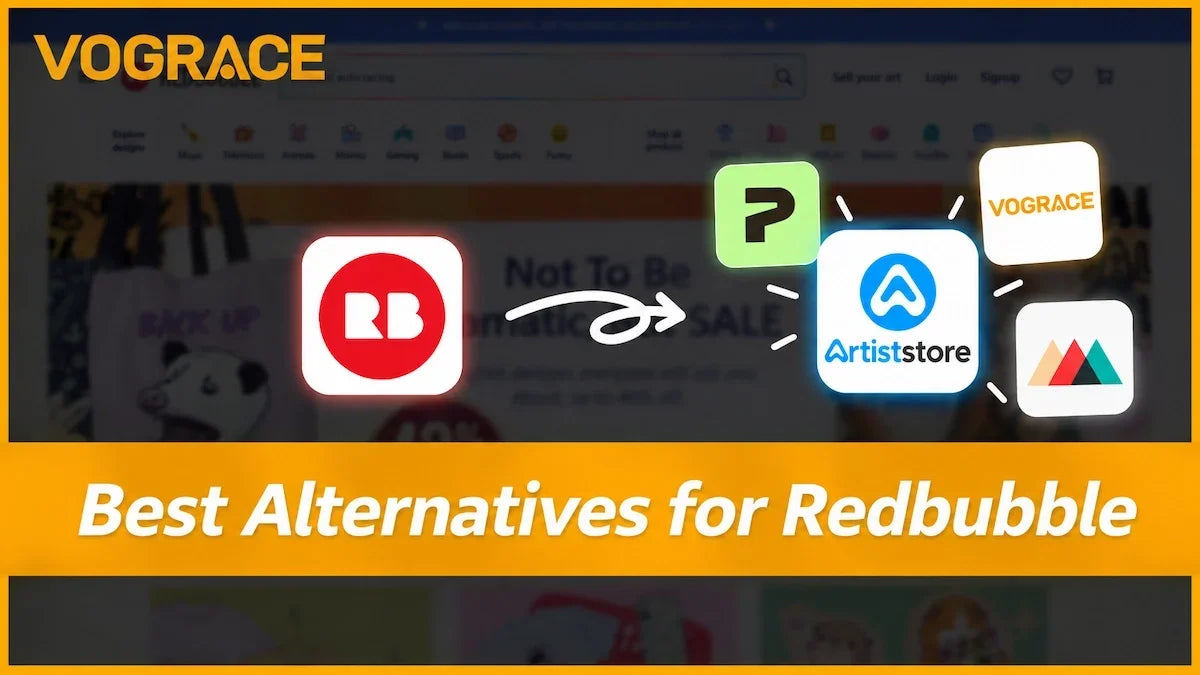
Redbubble makes it easy to upload a design, place it on products, and let someone else handle production and shipping. That simplicity is exactly why so many creators start there.
But it is not the only way to sell custom products online.
Some sellers want more control over their margins. Others want their own branded store instead of another profile inside a marketplace. Some need a wider product catalog, while established sellers may be ready to move beyond standard print-on-demand and manufacture more distinctive merchandise.
That is why the best Redbubble alternatives are not all direct Redbubble lookalikes.
They generally fall into four groups:
POD marketplaces, where customers can discover products directly; POD fulfillment platforms, which connect production to your own sales channels; storefront + POD platforms, which give you a more independent online shop; and custom manufacturers, which become useful when you want more control over the physical product itself.
Below, we compare ten strong options across those models. The list is not a strict ranking—Printify, TeePublic, Artiststore, Etsy, and Vograce solve very different problems. The better question is not simply “Which site is best?” but “How do I want to sell, produce, and grow?”
Best Redbubble Alternatives at a Glance
|
Platform |
Main Model |
Built-In Marketplace |
Inventory Required? |
Store/Brand Control |
Best For |
|
Printify |
POD fulfillment |
No* |
No |
High through connected stores |
Large product choice and ecommerce integrations |
|
Printful |
POD fulfillment |
No* |
No |
High through connected stores |
Branded POD fulfillment |
|
TeePublic |
POD marketplace |
Yes |
No |
Limited |
Straightforward marketplace selling |
|
Artiststore |
Storefront + POD + marketplace |
Yes |
No |
High |
Custom merch stores without inventory |
|
Fourthwall |
Storefront + POD |
No |
No |
High |
Creators building a branded direct-to-fan store |
|
Zazzle |
Marketplace + customization |
Yes |
No |
Moderate |
Personalized gifts, stationery and customizable products |
|
Vograce |
Custom manufacturing |
No |
Usually some inventory |
Very high product control |
Custom merch and small-batch production |
|
Amazon Merch on Demand |
POD marketplace |
Yes, via Amazon |
No |
Limited |
Selling designs through Amazon |
|
Etsy |
Marketplace |
Yes |
Depends on fulfillment model |
High shop control |
Handmade, designed and niche creative products |
|
Spreadshop |
Storefront + POD |
No |
No |
Moderate to high |
Simple POD storefronts |
*Printify and Printful primarily function as fulfillment services, although they also offer certain storefront tools. Their main strength is connecting production with external ecommerce channels rather than relying on a marketplace audience. Printify currently integrates with channels including Etsy, Shopify, TikTok Shop, Amazon, eBay, WooCommerce and others; Printful likewise supports ecommerce integrations and its own Quick Stores.
10 Best Redbubble Alternatives in 2026
1. Printify — Best for Product Variety and Ecommerce Integrations

Printify is one of the most established alternatives for sellers who want to move away from a marketplace-only setup.
Instead of putting your designs inside a central marketplace like Redbubble, Printify operates primarily as a print-on-demand fulfillment network. You select products, add your designs, connect a sales channel, and Printify’s production network handles manufacturing and delivery after an order is placed.
Its current catalog includes more than 2,000 product options, and Printify supports integrations with major ecommerce platforms and marketplaces.
That makes it particularly useful when your goal is not simply to find “another Redbubble,” but to build a POD business across your own channels.
Pros: The product selection is broad, there is no inventory requirement, and sellers can connect Printify to several major ecommerce platforms. The network model can also provide more choice in production locations and suppliers.
Cons: Printify itself is not primarily a consumer marketplace. You still need somewhere to sell and, in most cases, a strategy for attracting customers. Because different print providers may fulfill different products, sellers should compare provider pricing, location and specifications rather than assuming every option is identical.
Best for: Ecommerce sellers, small brands and creators who already have—or plan to build—their own sales channels and want a large POD catalog.
2. Printful — Best for Branded Print-on-Demand Fulfillment

Printful follows a similar broad model to Printify but places strong emphasis on integrated fulfillment and brand-building tools.
You can create products, connect a store and have orders automatically sent to Printful for production and fulfillment. Supported integrations include platforms such as Shopify, Etsy and WooCommerce. Printful is free to start, has no order minimum on its standard POD products, and charges fulfillment costs when orders are placed.
Its current free offering also includes hundreds of customizable products, mockup and design tools, and ecommerce integrations.
Pros: Printful provides a mature POD workflow, ecommerce integrations and useful branding options. No inventory is required, making it easy to test designs before committing money to stock.
Cons: Like Printify, Printful does not replace a marketplace audience. Sellers generally need a connected store, marketplace or other sales channel. Additional branding features, extra print placements, shipping and certain production options can also add to the base fulfillment cost.
Best for: Sellers who value a structured fulfillment system and want to build a recognizable brand through their own ecommerce channels rather than depend entirely on marketplace discovery.
3. TeePublic — Best for Simple Marketplace Selling

If what you like about Redbubble is the marketplace model itself, TeePublic is one of the more direct alternatives in this list.
Creators upload designs and publish them across available merchandise, while TeePublic handles production through third-party fulfillment partners and sells the products through its marketplace. TeePublic says its catalog covers more than 75 product types.
It is therefore much closer to the familiar “upload your art and let the platform handle the rest” experience than services such as Printify.
There is one important difference to understand: TeePublic uses regular and sale prices with fixed artist earnings, rather than allowing creators to freely set product prices.
Pros: Joining and uploading designs is free, production and customer orders are handled through the platform, and sellers can access an existing marketplace rather than building a complete ecommerce operation from scratch.
Cons: There is less control over pricing and the overall customer experience than you would have with your own store. Earnings also vary according to TeePublic’s account categorization and whether a product sells at regular or promotional pricing.
Best for: Designers and creators who prioritize marketplace simplicity and do not want to manage production, inventory or a separate ecommerce site.
4. Artiststore — Best for Selling Custom Merch Without Holding Inventory
 Artiststore takes a different approach: it combines a creator-focused storefront with print-on-demand production and fulfillment.
You can create your own store, upload designs, choose products and set retail prices without purchasing inventory first. When an order comes in, Artiststore handles production, fulfillment and customer service. Its current platform also supports an Artiststore marketplace in addition to individual creator shops.
Artiststore is especially notable for its focus on custom creative merchandise. Its product options include categories such as keychains, stickers, pins, prints, home products and apparel rather than focusing almost entirely on conventional apparel POD.
According to Artiststore, opening and listing products currently has no monthly fee or platform sales commission, while fulfillment costs are charged as products are produced. Sellers can set their own prices, and payments can go to their connected Stripe or PayPal account.
Pros: There is no inventory requirement, sellers have their own storefront, pricing remains under the seller’s control, and production and fulfillment are handled within the same ecosystem. The range of creative merchandise makes it particularly relevant for illustrators, merch designers and small creator brands.
Cons: Artiststore currently focuses on physical POD products rather than digital products. A standalone storefront also does not remove the need for promotion: marketplace exposure can help, but sellers should still expect to build traffic through social media, communities, search or an existing audience.
Best for: Creators, designers and merch sellers who want an independent-looking store and a broader custom-merch focus without buying stock or managing fulfillment themselves.
5. Fourthwall — Best for Building a Creator-Focused Online Store

Fourthwall is less like a traditional POD marketplace and more like a creator commerce platform.
Users can launch customizable shops, sell physical products, offer digital products and run memberships. Fourthwall also provides production, shipping and customer support for supported merchandise. The platform currently advertises hundreds of available products and no monthly or upfront platform fee for getting started.
The main difference from Redbubble is ownership of the storefront experience. Rather than listing your products beside thousands of competing designs in the same marketplace interface, Fourthwall is built around giving a creator a branded destination.
Pros: Strong storefront customization, no inventory requirement for supported POD products, membership features, custom domain options and a broader creator-business toolkit.
Cons: Fourthwall is not primarily a marketplace where you can simply upload designs and depend on platform search traffic. Its strengths become more valuable when you already have—or actively build—an audience.
Best for: YouTubers, streamers, creators, communities and brands that want their merch store to feel like part of their own online identity.
6. Zazzle — Best for Personalized Products and Marketplace Reach
 Zazzle remains one of the more distinctive alternatives because personalization is deeply built into the shopping experience.
Its marketplace covers a wide mix of categories including invitations, stationery, gifts, clothing, accessories, home products, stickers and event merchandise. Creators can open a free Zazzle store, set royalty rates for their designs within Zazzle’s system, and earn royalties when products containing those designs sell. Zazzle handles fulfillment and customer service.
That makes Zazzle particularly strong where the customer wants to do more than simply choose a graphic—they may want to change text, names, dates, photos or other product elements.
Pros: Built-in marketplace traffic, a very broad range of personalized product categories and no need to handle manufacturing or customer fulfillment yourself.
Cons: Like other marketplaces, your business operates inside the platform’s ecosystem. Store branding and customer relationships are not as independent as they would be on a standalone ecommerce site.
Best for: Designers working with invitations, gifts, weddings, events, stationery, personalized products and other designs where customer customization adds value.
7. Vograce — Best for Custom Merch and Small-Batch Production
 Vograce is the outlier in this list—and that is exactly why it belongs here.
It is not a Redbubble-style marketplace and should not be treated as one. Vograce is a custom merchandise manufacturer designed for people who want more control over what the finished product actually is.
Rather than selecting only from a standard POD catalog, sellers can create products such as acrylic keychains, standees, pins, stickers, cards, bags, plush-related merchandise and products with specialized materials or finishes.
Many Vograce product lines now support very low or no minimum order quantities, including a dedicated no-MOQ collection that allows certain products to be ordered from one piece. Minimums still vary by product—for example, some sticker products are sold in sets with a minimum of 10 stickers per design.
That distinction matters.
Redbubble is designed to let you sell without handling production. Vograce is better suited to people who want to become more involved in the merchandise itself.
Pros: Far greater scope for custom merch formats, materials, accessories and specialized effects than a typical POD marketplace. Low-MOQ options also make sampling and small launches more accessible than traditional high-volume manufacturing.
Cons: Vograce is not your sales marketplace or storefront. If you manufacture merchandise, you still need to decide where it will be sold and how inventory and order fulfillment will be handled. Some product categories also have minimum quantities, so sellers should check individual product requirements rather than assume everything can be ordered one at a time.
Best for: Small brands, creators, convention sellers and merch businesses that have validated a design—or simply want something more distinctive than standard POD—and are ready to produce physical inventory.
For sellers who want Vograce-style merchandise without holding that inventory themselves, Artiststore represents the POD/storefront side of the same broader ecosystem. Vograce focuses on custom manufacturing and supply-chain services, while Artiststore focuses on store creation and made-to-order fulfillment.
8. Amazon Merch on Demand — Best for Access to Amazon Shoppers

Amazon Merch on Demand puts the sales channel first.
Creators submit original artwork, select available products and set a list price. Once a product is approved and published, it appears on Amazon, while Amazon handles production, shipping and customer service. The creator receives a royalty based on the selling price after applicable Amazon costs.
There is no need to purchase inventory upfront, making the model structurally similar to Redbubble in one important respect: products are produced only after somebody buys them.
The biggest difference is where the purchase happens—inside Amazon’s enormous retail ecosystem.
Pros: No upfront inventory requirement, Amazon-managed production and fulfillment, and products can be purchased through a marketplace consumers already know.
Cons: Product and storefront customization are much more limited than building your own independent ecommerce brand. You are also operating within Amazon’s approval, listing and royalty structure rather than controlling the full commerce experience.
Best for: Designers and brands that value Amazon as a sales channel and are comfortable prioritizing marketplace reach over independent storefront customization.
9. Etsy — Best for Sellers Who Want More Marketplace Control

Etsy is often grouped with Redbubble alternatives, but the comparison needs one major clarification:
Etsy is a marketplace, not a print-on-demand manufacturer.
You create and manage the shop. If you need production, you can make the products yourself or work with an eligible production partner.
Etsy explicitly allows sellers to use third-party production partners—including POD companies—when the seller is the creative force behind the original design and properly discloses the production partner.
That flexibility means an Etsy shop can be paired with Printful, Printify or another manufacturer, or used to sell inventory you have produced separately.
Pros: A large established creative marketplace, more control over individual listings and shop presentation than many upload-and-earn POD marketplaces, and flexibility in how qualifying original products are manufactured.
Cons: Etsy does not remove manufacturing decisions from the equation. Sellers need to manage listings, fulfillment arrangements and compliance with Etsy’s creativity and production-partner rules. Ordinary resale or dropshipping of products the seller did not design is not permitted simply because a third party can ship them.
Best for: Creative businesses that want marketplace exposure while retaining more control over their product strategy, production partners and shop identity.
10. Spreadshop — Best for Combining a Storefront With POD

Spreadshop sits between a traditional POD fulfillment provider and an independent store builder.
You can create a custom storefront, add designs to products and set selling margins. When an order is placed, Spreadshop handles printing, shipping and customer service. The platform currently describes its storefront as free to use with no upfront inventory requirement.
That makes it simpler than building a Shopify store and then separately choosing a fulfillment provider, while still giving you more of a standalone store presence than a conventional marketplace listing.
Pros: Free storefront setup, made-to-order fulfillment, no stock requirement and straightforward margin-based pricing.
Cons: Spreadshop is primarily your own POD storefront rather than a marketplace discovery engine, so audience-building still matters. Its model is also more centered on standard printed merchandise than highly specialized custom manufacturing.
Best for: Creators, communities and small brands that want a relatively simple branded POD shop without assembling several separate ecommerce tools.
Marketplace vs. POD Platform vs. Your Own Store: What’s the Difference?
Calling all ten options “Redbubble alternatives” is useful for search, but it can hide the most important decision: they are not all replacing the same part of Redbubble.
Redbubble combines product creation, marketplace discovery, payment handling and fulfillment in one ecosystem. Moving away from it often means deciding which of those functions you still want a platform to handle.
|
Selling Model |
Examples |
What It Handles Well |
Main Trade-Off |
|
POD Marketplace |
Redbubble, TeePublic, Zazzle, Amazon Merch on Demand |
Marketplace listings, production and fulfillment |
Less control over storefront, pricing or customer experience |
|
POD Fulfillment Provider |
Printify, Printful |
Production and automated fulfillment |
You usually need your own sales channel |
|
Storefront + POD |
Artiststore, Fourthwall, Spreadshop |
Branded shop plus made-to-order fulfillment |
You need to generate more of your own traffic |
|
Creative Marketplace + External Production |
Etsy |
Marketplace exposure with production flexibility |
More seller responsibility and policy compliance |
|
Custom Manufacturing |
Vograce |
Product customization, special materials and small/bulk runs |
Inventory and sales channels need separate planning |
This distinction also explains why there is no universally best Redbubble replacement.
Someone selling ten T-shirt graphics has very different needs from a small brand developing holographic acrylic charms, and both are different again from a creator with 200,000 followers who wants a standalone merch site.
Choose the business model first. The platform decision becomes much easier afterward.
How to Choose the Right Redbubble Alternative
Start with one question: What are you actually trying to change about Redbubble?
If the answer is “I still want a marketplace, just a different one,” focus on platforms such as TeePublic, Zazzle or Amazon Merch on Demand.
If you want control over your own ecommerce channel, look more closely at Printify or Printful paired with an external store.
If your priority is having your own merch storefront without managing inventory or fulfillment, Artiststore, Fourthwall and Spreadshop belong higher on your shortlist.
And if your real limitation is not the selling platform at all—but the types of merchandise you can make—custom manufacturing becomes more relevant.
The following factors matter most.
Traffic: Do you need customers to discover you through a marketplace, or do you already have an audience?
Inventory: Do you want every item made after an order, or are you comfortable keeping a small amount of stock?
Product control: Is putting a design on an existing blank product enough, or do materials, shapes, accessories and special finishes matter?
Brand control: Are you happy with a marketplace profile, or do you want customers to feel like they are shopping directly from your brand?
Margins: Compare more than the retail price. Look at production costs, marketplace fees, payment processing, shipping, discounts and any paid subscriptions.
Fulfillment: Decide whether you want to pack and ship orders yourself or leave the entire process to the platform.
The best option is usually the one that removes the work you do not want to do without also removing the control you actually need.
Can You Use More Than One Redbubble Alternative?
Absolutely—and for a growing merch business, that often makes more sense than trying to force one platform to do everything.
A marketplace can help you test whether people respond to a design. A POD storefront can keep that design available without tying money up in inventory. Once a product proves that it can sell consistently, small-batch manufacturing can open the door to more customization, better event preparation and different pricing strategies.
A practical path might look like this:
Test demand → sell through POD → identify proven products → manufacture selected designs → expand across online and offline channels
For example, a creator could keep made-to-order products available through Artiststore while ordering a small run of selected Vograce merchandise for conventions, photography, limited drops or bundles.
Another seller might run an Etsy shop connected to Printful, then move a successful design into custom-manufactured merchandise once the audience has already shown demand.
You do not have to graduate permanently from one model to another. POD and small-batch production can work together.
The point is to stop guessing.
Use low-risk methods when a design is unproven. Put more money and customization behind products once real customer behavior gives you a reason to do so.
Final Thoughts: Which Redbubble Alternative Fits Your Business?
There is no shortage of sites like Redbubble. The more useful distinction is what happens after you leave the Redbubble model.
If built-in marketplace discovery matters most, TeePublic, Zazzle, Amazon Merch on Demand or Etsy may make sense.
If you already have a store—or want to build one—Printify and Printful provide flexible fulfillment infrastructure.
If you want a storefront and POD handled in one place, platforms such as Artiststore, Fourthwall and Spreadshop reduce the number of systems you need to manage.
And if standard print-on-demand products no longer give you enough creative control, a custom manufacturer such as Vograce opens a different path: create the product itself rather than simply choosing where your design is printed.
Your first platform does not have to be your last, either.
Start with the level of risk and control that makes sense today. Test what people actually buy. Then build the next part of your business around evidence rather than inventory guesses.
Frequently Asked Questions About Redbubble Alternatives
What is the best alternative to Redbubble?
There is no single best option. TeePublic and Zazzle are closer to Redbubble’s marketplace model, Printify and Printful are better suited to sellers with external sales channels, while Artiststore and Fourthwall are designed around more independent storefronts.
What website is most similar to Redbubble?
TeePublic is one of the closest options in terms of the basic marketplace model: sellers upload designs, products are produced through fulfillment partners, and customers buy through the platform’s marketplace. TeePublic uses fixed artist earnings rather than seller-controlled product pricing.
Are Printify and Printful marketplaces like Redbubble?
Not primarily. Both are mainly POD fulfillment platforms that produce and ship products sold through connected ecommerce channels.
Can I sell print-on-demand products on Etsy?
Yes, as long as the products comply with Etsy’s Creativity Standards. Sellers may use production partners such as POD companies for their original designs, but the production partner must be disclosed where required.
Do I need inventory to sell custom merch online?
Not necessarily. Platforms including Redbubble, Printify, Printful, Artiststore, Fourthwall, Amazon Merch on Demand and Spreadshop can produce qualifying products after an order is placed. Small-batch manufacturing is another option when you want physical stock without committing to a very large run.
Is Vograce a print-on-demand marketplace?
No. Vograce is primarily a custom merchandise manufacturer, not a marketplace like Redbubble. It is better suited to sellers who want greater product customization or physical merchandise for their own stores, events or other sales channels.
Can I use POD and custom manufacturing at the same time?
Yes. POD works well for keeping products available without inventory, while custom manufacturing can make sense for proven products, specialized merchandise, events, bundles or larger releases. The two models can complement each other rather than compete.