How to Turn One Illustration Into 5+ Different Merch Products
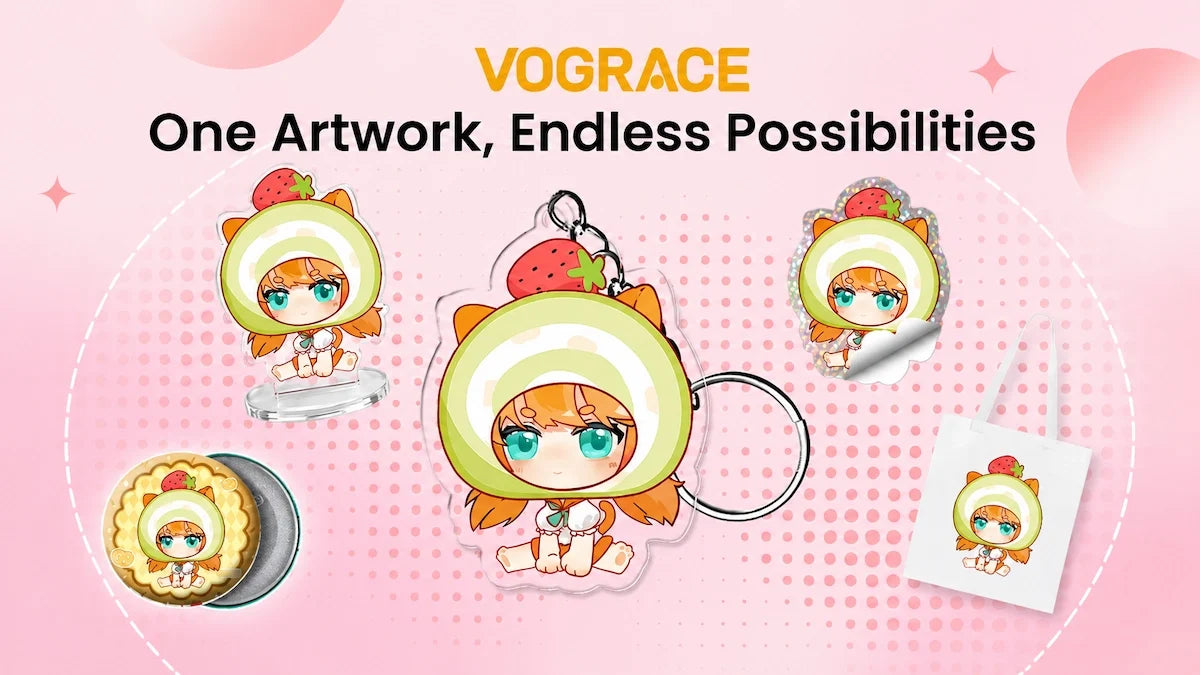
The same piece of art can become six completely different products — you just need to know how to crop it, layer it, adjust the color, and pick the right material for each one. In this post, we're breaking down a single original illustration across six of the most popular merch formats — keychains, stickers, acrylic standees, holographic cards, badges, and tote bags — with practical adaptation tips you can put to work on your own art right away.
1. Acrylic Keychains — Small Format, Big Presence

Acrylic keychains take an illustration off the page entirely, turning it into something with real dimension and translucency that fans actually carry around — on a backpack, a bag, a set of keys. It's one of the rare formats that's equally practical and eye-catching.
Adaptation tips:
· Because keychains print small, thicken up any fine linework and simplify tiny details — otherwise they'll blur or disappear once printed at that scale.
· Use a custom die-cut shape that hugs the character's silhouette instead of a plain rectangle. It trims the extra background and keeps the whole piece looking clean and intentional.
· This is the format fans wear into daily life, which makes it a low-barrier, high-loyalty staple in almost any merch lineup.
2. Stickers — The Most Flexible Format You'll Print

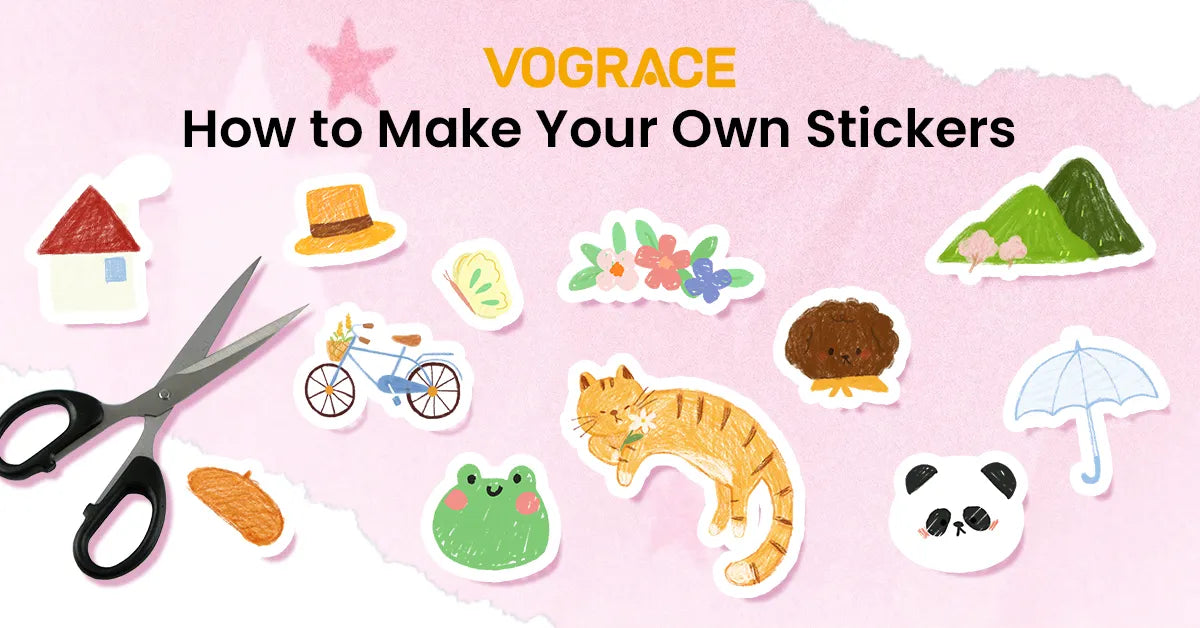
Stickers are the most adaptable product on this list. There's no fixed display case and no single "correct" surface — one design can live on a dozen different objects, which makes them some of the best value-for-money merch you can offer.
Adaptation tips:
· Clean up the edge lines before you send the file off. Thin, jagged linework is the most common cause of tearing or uneven peeling during die-cutting.
· Sell a design as a standalone sticker, or bundle several into one themed sticker sheet or set for a higher perceived value.
· Laptops, phone cases, journals, gift box packaging — the use cases are nearly endless, and the cost of entry for fans is close to zero, so this format reaches the widest audience on this list.
3. Acrylic Standees — Turning a Flat Illustration into Desktop Art

Standees change how an illustration gets experienced altogether — from something printed to something displayed, a small, self-standing piece of desktop art. They also hold onto more of the original piece's mood and detail than almost any other format, which is why standees tend to read as the "premium" item in a set.
Adaptation tips:
· Leave clear space at the bottom for the base slot when you're laying out the design, so it doesn't cut into the face, outfit, or any detail you actually want people to see.
· Keep the background, lighting, and gradients intact wherever possible — standees are the format where an illustration's full atmosphere gets to shine, so don't crop that away.
· Great for desk displays, boxed sets, and higher-end collector pieces.
4. Holographic Cards — The Collector's Upgrade

Holographic cards are the leveled-up version of a flat illustration — light-and-shadow processing gives a static image real movement, which pushes up both the sense of scarcity and the collectible value. It's a go-to for fan-made merch drops and limited box sets.
Adaptation tips:
· Bold, simple color blocks and gradients pick up the holographic shimmer best. Busy, detail-heavy art tends to fight the light effect instead of showing it off, so simplify where you can and let large clean areas of color do the work.
· Perfect for limited runs, convention exclusives, freebie or bonus cards, and small collector sets.
5. Button Badges — Fandom's Favorite Currency

Badges are the hard currency of fandom merch culture, and the format an illustration lands in most directly. The small, tidy round or square shape forces you to simplify down to the character and the strongest visual hook — which, done right, actually makes the design more recognizable, not less.
Adaptation tips:
· Crop in tight around the character and whatever detail is the strongest hook. Trim anything sitting at the edges that isn't pulling its weight.
· Push the contrast up a touch so the design still reads clearly from a few feet away once it's pinned to a bag, jacket, or hat.
· Ideal for event freebies, blind box sets, and low-cost, entry-level badges — often the first thing a new fan picks up.
6. Canvas Tote Bags — From Wall Art to Everyday Wardrobe

Tote bags give you the biggest wearable canvas on this whole list, letting a full composition and its atmosphere show up in one piece instead of getting chopped into fragments. It's what turns a design from a niche collectible into something people actually wear out the door.
Adaptation tips:
· A large surface area usually means you can use the full original composition without heavy cropping.
· Fabric printing can't hold ultra-fine pixel-level detail, so simplify the smallest details and let the overall composition and color mood carry the design instead.
· Works well for everyday commuting, student style, and gift sets — tote bags reach an audience well beyond your usual hardcore collector base.
One Illustration, a Whole Product Line
Merch production isn't locked behind factory-scale minimums anymore. The rise of small-batch, no-MOQ custom printing means individual artists can build and launch a full product line without needing a warehouse — or a five-figure up-front order. It saves real design time and cost, while letting you stand up a varied, professional-looking catalog fast. And a fuller catalog is exactly what turns a passionate fanbase into real, recurring commercial value for your work.
Found this useful? Share it with another artist who's still deciding what to make first — and if there's a product or topic you'd like us to break down next, send us a note. We're always happy to hear what you want to see covered.