Is Small-Batch Custom Merch the Future for Independent Artists?
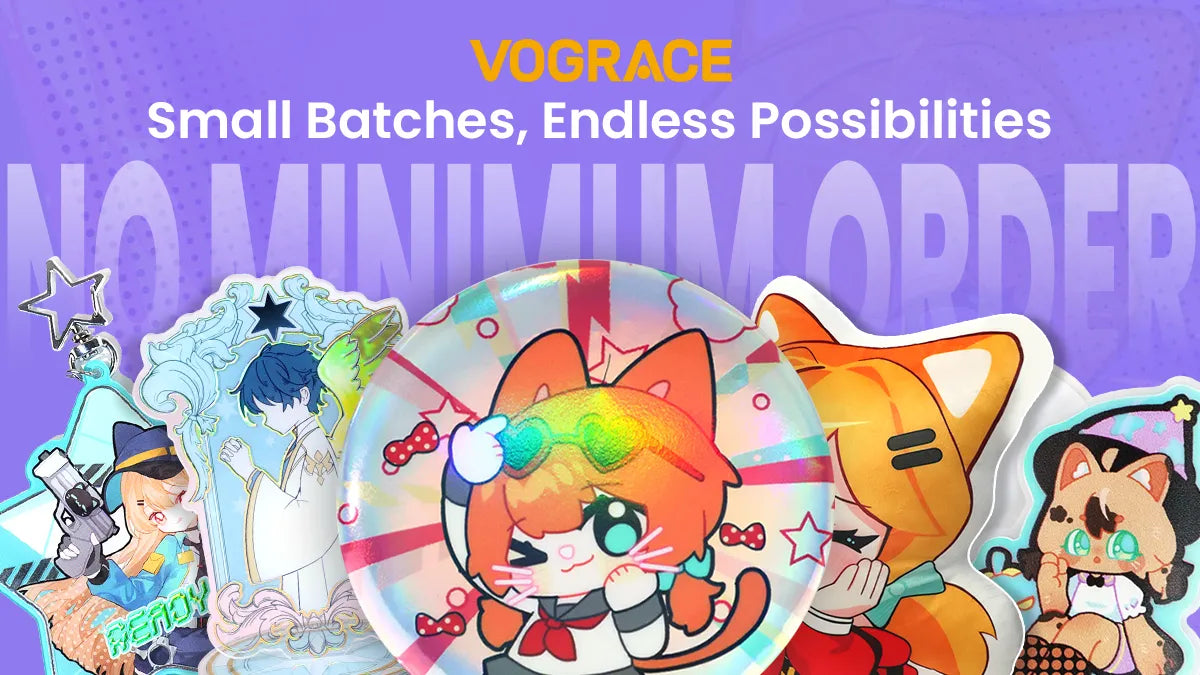
For independent artists, turning an illustration into an acrylic keychain, pin, standee, or sticker is about more than putting artwork on a product. Merch can help build a recognizable creative brand, connect with fans, and create another source of income.
But once it's time to make those products, a practical question comes up: should you order hundreds of units to bring down the cost per piece, or start with a few dozen and see what actually sells?
Traditional large-batch manufacturing relies on economies of scale. Small-batch custom merch production puts more emphasis on flexibility, matching supply to demand, and keeping the initial inventory investment manageable. Neither approach is automatically better. Each serves different needs and comes with different risks.
For established brands with predictable orders, larger runs may offer meaningful cost advantages. For independent artists with smaller audiences, evolving styles, or untested designs, a smaller run may be a more sensible place to start.
So could small-batch manufacturing move from a backup option to a standard way for independent artists and smaller creative IP brands to produce merch?
To explore that question, we'll look at cost, production efficiency, quality control, and inventory risk, then consider which approach makes sense at different stages of an artist's business.
Why Independent Artists Are Rethinking Merch Production
Followers Don't Always Become Customers
Follower counts, likes, and shares show that people are noticing your work. They don't necessarily tell you how many people will buy a physical product.
An artist with a few hundred highly engaged followers might sell merch successfully because their visual style resonates with a dedicated audience. Another creator with a much larger following could miss their sales target if the product, price, or design doesn't match what that audience wants.
The number that matters is not just how many people follow your art, but how many are willing to pay for a particular design on a particular product.
Without reliable sales history, it's hard to know whether a new design will sell 30 units, 300 units, or more. Ordering a large quantity before that demand has been tested turns an uncertain forecast into a very real inventory commitment.
The Lowest Unit Price Isn't Always the Best Deal
Imagine an artist launching acrylic keychains featuring three original characters.
Ordering a large batch of each design may reduce the price per keychain, but it also means spending more upfront on every character. If one design sells slowly, unsold stock can tie up cash and take up storage space for months.
Smaller runs may cost more per piece, but they allow the artist to see which characters connect with buyers before committing to a larger order.
That means looking beyond the price on a manufacturing quote. Ask yourself:
•Can I comfortably afford the upfront order?
•Will production and delivery fit my launch schedule?
•Will the finished product meet my standards and my fans' expectations?
•What happens to my cash if some of the stock doesn't sell?
•Will I still have enough budget for the next design or product launch?
The right production plan should support the business as a whole, not just make one purchase look cheaper.
Small-Batch vs. Large-Batch Manufacturing: What's the Difference?
Small-batch manufacturing generally means producing a relatively limited quantity of items, with product specifications, finishes, or artwork tailored to the order. Large-batch manufacturing uses bigger production runs to spread certain fixed costs over more units and make fuller use of established production processes.
There is no universal quantity that separates the two. What counts as a small batch depends on the product, the complexity of its production, the supplier's minimum order quantity (MOQ), and how production is scheduled.
|
Factor |
Small-Batch Custom Production |
Traditional Large-Batch Production |
|
Upfront investment |
Usually lower; easier to invest in stages |
Usually higher; requires more capital upfront |
|
Cost per unit |
Often higher |
Often lower when economies of scale apply |
|
Responding to demand |
Easier to adjust future runs |
Changes to already-produced stock can be costly |
|
Testing products |
Well suited to new designs and techniques |
Better suited to established products with clearer demand |
|
Production efficiency |
Flexible across smaller orders |
Often more efficient when processes and volumes are stable |
|
Quality control |
Samples and small runs can reveal issues early |
Standardized processes and batch inspections support consistency |
|
Inventory risk |
Usually less stock committed per order |
Overproduction can be costly if demand is misjudged |
|
Best use cases |
New launches, testing several designs, early sales |
Proven bestsellers, mature products, predictable large orders |
Small-batch doesn't mean every item must be individually unique, just as large-batch doesn't mean a product can never be customized. The real difference is how you balance unit cost, flexibility, available cash, and uncertainty about demand.
For artists exploring different product formats, Vograce offers custom acrylic keychains, stickers, pins, standees, cards, and other merch categories that can help you compare production options and order quantities.

Example of a Vograce custom product page and available ordering options.
Cost: Does a Lower Unit Price Really Save You Money?
Why Larger Orders Often Cost Less per Piece
Some manufacturing expenses don't rise in direct proportion to the number of items produced. Depending on the product, these may include molds, printing setup, equipment adjustments, and other preparation costs.
When those costs are spread across a small order, each item carries a larger share. With a larger run, the same setup expense may be divided among more pieces.
Consider this hypothetical example: production setup costs $100, and manufacturing each item costs $2. Shipping, packaging, taxes, and selling expenses are excluded.
|
Order Quantity |
Total Production Cost |
Average Cost per Unit |
|
30 units |
$160 |
$5.33 |
|
100 units |
$300 |
$3.00 |
|
500 units |
$1,100 |
$2.20 |
The average manufacturing cost falls as the order grows. These figures simply illustrate how fixed costs can be spread across different quantities; they are not actual Vograce prices. Real quotations depend on the product, specifications, order size, and purchasing terms.
A Lower Unit Cost Doesn't Guarantee Higher Profit
Suppose you sell the item above for $8 each. A 30-unit run costs $160 to manufacture. If every unit sells, revenue is $240, leaving $80 after production costs, before the other expenses excluded from this example.
Now suppose you order 500 units for $1,100 but still sell only 30. Revenue is still $240, and 470 units remain unsold. Those items might generate sales later, but until then, your money is tied up in stock. Storage, inventory management, and promotions may add further costs.
When comparing order quantities, don't stop at “Which order has the cheapest unit price?” Consider four more useful questions:
•How many units do I realistically expect to sell?
•How long might it take to sell them?
•Can I afford to hold the leftovers if demand is lower than expected?
•Will this order leave enough money for my next release?
Calculate the Full Cost, Not Just the Manufacturing Quote
To understand what a product will really cost your business, account for:
•Manufacturing and production setup
•Samples, molds, and printing plates, where applicable
•Packaging and order processing
•International shipping and import charges, if applicable
•Payment processing and sales-channel fees
•Storage, returns, exchanges, and customer support
•Potential losses on unsold stock
Where Vograce fits: If you'd like to buy custom merch and manage your own stock, compare different production quantities against your budget and sales expectations. For a new product, comparing the total cost of sampling, a small run, and a larger run usually tells you more than comparing unit prices alone.
Production Efficiency: Bigger Batches or More Flexibility?
Efficiency isn't just about how quickly a factory can manufacture items. For an artist, it also includes the journey from a new idea to a product that's been tested with real customers.
When Large-Batch Production Is More Efficient
Once a product has demonstrated consistent demand and its manufacturing process is well established, bigger runs can make practical sense.
For example, if the same popular character keychain has sold steadily for months, ordering more units at once may reduce the number of repeat orders, production setups, and back-and-forth messages with a supplier.
When Small Batches Are More Efficient
The picture changes when you're experimenting with a new character, art style, or product format.
An initial run allows you to inspect the physical result, gather feedback, and observe actual sales. If the response is strong, you can reorder or scale up. If it isn't, you can revise the design or try a different product.
That won't necessarily make factory production faster. It can, however, reduce the time and money lost to avoidable redesigns, incorrect assumptions about demand, and excess stock.
Small Orders Don't Automatically Mean Fast Delivery
Lead times also depend on sample approval, material availability, the supplier's production schedule, manufacturing techniques, and shipping arrangements.
If you're preparing for an artist alley, anime convention, or holiday launch, confirm production and shipping timelines well in advance—even for a relatively small order. Good planning is about matching production to your sales calendar, not simply choosing the shortest advertised turnaround.
Where Vograce fits: Check the production requirements and estimated schedule for your selected product, and confirm any proofing steps and shipping arrangements before ordering. Planning ahead matters especially for event-exclusive merchandise.
Quality Control: Are Smaller Batches Easier to Get Right?
For fan merchandise, product quality affects more than how an item looks or feels. It also shapes how customers perceive and trust an artist's brand.
Print colors, line sharpness, material feel, edge finishing, attached hardware, and protective packaging all contribute to the finished product.
Small Batches Can Reveal Problems Early
When a design is untested, a sample or small trial order gives you a chance to inspect the real item before investing in a larger run.
An illustration might look crisp on a monitor but lose fine lines or tiny lettering when reduced to keychain size. Printed colors may also appear different from those on a screen.
Reviewing a sample or first small batch lets you adjust the artwork file, dimensions, or production specifications while changes are still manageable.
Large Runs Depend on Consistent Processes
Large-batch production can deliver excellent quality too. What matters is whether the manufacturer has clear standards, controlled processes, and reliable inspection procedures.
If a material or production setting is wrong, a larger batch may simply magnify the impact of that mistake.
In other words, order quantity alone doesn't determine quality. Supplier capability, quality management, and clear agreement on product specifications matter more.
Inventory Risk: Why Artists Need to Think Beyond Sales Forecasts
The Pressure of Unsold Stock
Imagine ordering 500 items because you expect to sell 300 over three months. If you sell only 100, you're left with 400 unsold pieces.
You may eventually sell some of them. You might also need discounts, bundles, or other promotions to move them. Meanwhile, money already spent on production isn't available for new products, marketing, or everyday business expenses.
If you're launching multiple characters and product lines at once, the inventory commitment can quickly add up.
How Small-Batch Orders Help Manage Risk
Ordering fewer items at a time lets you make production decisions closer to actual demand. This is especially useful when you:
•Are turning your original artwork into physical merch for the first time
•Want to test a new character, design, or product category
•Have a modest audience but clear signs of purchase interest
•Need convention or event stock without a dependable sales history
•Want to try several designs without betting your entire budget on one
Small-batch production doesn't eliminate risk. If the products don't sell, you can still lose money. Higher per-unit manufacturing or shipping costs can also put pressure on your margins. The aim is to take on a level of risk you can manage—not to pretend there is none.
Will Small-Batch Custom Merch Become the Norm?
Our view is that small-batch custom production could become one of the more important supply-chain options for independent artists and smaller creative IP brands. That doesn't mean it will replace large-scale manufacturing.
Four business trends help explain why a more flexible approach may appeal to creators.
1. New Products Will Be Tested Against Real Demand
An independent artist's catalog is often highly personal, and two characters from the same creator can sell very differently.
A small initial order or a preorder campaign can help test interest before committing more capital. Over time, actual orders and sales performance may become more useful production signals than follower counts or intuition alone.
2. More Designs Can Be Tested in Smaller Runs
Artists who create multiple characters can use smaller batches to experiment with different products, finishes, and artwork variations.
Instead of ordering large quantities of every design, they can direct their budget toward the products that perform best. There is a trade-off, however: more SKUs also mean more order tracking, replenishment decisions, and operational complexity.
3. Creators Need More Than a Manufacturer
For an independent artist, the question may increasingly be not just “Where can I get this made?” but “How do I manage the whole process of selling my work?”
Product development, stock management, online storefronts, and order fulfillment are all part of the decision. Different services can support different approaches.
Vograce focuses on custom merch manufacturing for creators who want to choose their products and order quantities. Artiststore offers an online storefront and on-demand fulfillment model for artists who want to sell their designs with less need to purchase inventory upfront.
The two approaches aren't mutually exclusive. The right combination depends on how you want to run your business today.
4. A Hybrid Production Strategy May Work Best Long-Term
When demand is uncertain, a small run, preorder, or made-to-order approach can help reduce early commitments. Once a product has a steady sales record, a larger batch might improve its cost structure.
A practical way to think about it is:
•New design: Validate interest through samples, small batches, or preorders.
•Early bestseller: Adjust reorder quantities using actual sales and replenishment needs.
•Established bestseller: Compare the cost advantages of a larger run with inventory turnover.
•Ongoing product line: Keep room in the budget to test new designs regularly.
This kind of tiered approach can combine flexibility for new products with economies of scale for proven sellers.
These are forward-looking judgments based on production costs and the way creator-led businesses operate, not firm predictions about future market share.
How to Choose a Production Model for Your Stage
|
Your Current Situation |
Approach to Consider |
What to Focus On |
|
Making merch for the first time |
Samples, small batches, or preorders |
Validate the design, physical quality, and buying interest |
|
Seeing your first consistent sales |
Smaller runs with staged reorders |
Adjust quantities based on real sales data |
|
Selling a proven bestseller |
Evaluate larger production runs |
Compare unit cost, inventory turnover, and cash flow |
|
Managing several characters or collections |
A tiered production strategy |
Match each product to its own demand pattern |
|
Prefer not to buy inventory upfront |
Explore on-demand production |
Check margins, fulfillment times, and platform policies |
If you're making your first merch collection, there's no need to place the biggest possible order. Start by checking whether the product suits your artwork, whether the total cost is manageable, and whether customers are ready to buy.
Once the product has proved itself, you can increase production with more confidence. A measured approach can still support a sustainable creative business.
Final Thoughts: The Future Belongs to Flexible Creators
Will small-batch custom merch become the standard for independent artists? It may become an increasingly valuable option, especially for creators who want to experiment with new designs without committing too much money upfront.
But larger runs won't lose their place. When demand is stable, sales are predictable, and the savings are substantial, producing more at once may still be the better decision.
The creators best equipped for the long term may not be those who always order small quantities. They'll be the ones who adapt their production strategy to a product's lifecycle, sales performance, and available cash.
If you're planning your first piece of merch, compare product requirements and quantity-based pricing before deciding whether to buy stock or use an on-demand storefront model.
Vograce helps creators turn original artwork into physical merch through custom manufacturing. Artiststore offers another route for artists who want to build an online shop while reducing the need to hold inventory in advance.
Whatever you choose, production should serve your creative and business goals—not dictate what you make next.
Before ordering, ask yourself one question: do I need the lowest possible unit cost, a more manageable inventory risk, or an easier way to sell my work? Your answer will point you toward a better-fit production model.