Postcard Size Guide: Standard Sizes, Pixels & Mailing Rules
A postcard can be a quick note, a piece of collectible art, or a small but memorable part of an order. Its size changes more than how much space you have to work with: it also affects the image crop, print setup, and—if you intend to mail it—the postage you'll need.
The most common postcard size in the U.S. is 4 × 6 inches (102 × 152 mm). It is an easy format to design and, when the paper and layout meet USPS requirements, qualifies for the retail First-Class Mail postcard rate. The familiar 5 × 7-inch card offers more room for artwork and text, but it does not qualify for that same retail postcard rate.
Below you'll find a detailed postcard size chart, pixel dimensions for print, U.S. mailing limits, and a practical way to pick the right format for your project.
What Is the Standard Postcard Size?
In the United States, 4 × 6 inches is the most widely recognized standard postcard format. It's large enough for a photograph or illustration on one side and a short message or address on the other, without feeling like a flyer.
However, “standard” can mean different things:
·Standard printing size: a commonly sold format, such as 4 × 6 or 5 × 7 inches.
·Standard postal-rate size: a card that satisfies a postal service's rules for a particular postage category.
·Standard regional size: a format used in a specific market, such as A6 in many international print shops or 100 × 148 mm for a typical Japanese postcard.
There is no single worldwide postcard dimension. Decide whether the card is for mailing, handing out, or collecting before choosing a template.
Common Postcard Sizes and Dimensions
The chart below covers widely sold printing formats as well as compact art cards and oversized mailers. Measurements are finished trim sizes, not files with bleed. Metric figures for inch-based sizes are rounded to the nearest millimeter.
|
Postcard format |
Inches (W × H) |
Metric size (approx.) |
Typical use |
|
Mini square art card |
3 × 3 in |
76 × 76 mm |
Tiny collectible prints and packaging inserts |
|
Mini art card |
3 × 4 in |
76 × 102 mm |
Small inserts, mini illustrations |
|
Small / Vograce option |
3 × 5 in |
76 × 127 mm |
Thank-you notes, packaging cards |
|
USPS retail minimum |
3.5 × 5 in |
89 × 127 mm |
Compact mailed postcards |
|
Standard U.S. |
4 × 6 in |
102 × 152 mm |
Everyday postcards, photography, art |
|
Vograce heat-sensitive option |
3.94 × 5.91 in |
100 × 150 mm |
Interactive, heat-reveal postcards |
|
Japanese postcard |
3.94 × 5.83 in |
100 × 148 mm |
Japanese postcard-style prints |
|
A6 (ISO) |
4.13 × 5.83 in |
105 × 148 mm |
International postcards, invitations |
|
Compact promotional |
4.25 × 5.5 in |
108 × 140 mm |
Promotional and greeting-style cards |
|
USPS retail maximum |
4.25 × 6 in |
108 × 152 mm |
Largest retail postcard-rate format |
|
Square art card |
5 × 5 in |
127 × 127 mm |
Square artwork and collectibles |
|
Large standard |
5 × 7 in |
127 × 178 mm |
Art postcards, keepsakes, invitations |
|
Half-page |
5.5 × 8.5 in |
140 × 216 mm |
Event information, promotional handouts |
|
A5 (ISO) |
5.83 × 8.27 in |
148 × 210 mm |
Large illustrations and mini art prints |
|
Oversized art card |
6 × 8 in |
152 × 203 mm |
Display pieces, larger artwork |
|
Large mailer |
6 × 9 in |
152 × 229 mm |
Direct-mail campaigns, announcements |
|
Jumbo mailer |
6 × 11 in |
152 × 279 mm |
High-visibility promotional mailers |
|
Slim rack card |
3.67 × 8.5 in |
93 × 216 mm |
Brochures, event counters, rack displays |
The name “postcard” on a print product does not automatically mean it qualifies for postcard postage. See the USPS section below.
4×6 Inch Postcards: The Everyday Standard
The 4 × 6 postcard is the safest starting point for most projects. It suits a full-bleed photograph, a character illustration, a travel scene, or a simple thank-you message. Its 2:3 ratio is familiar and makes it easy to reuse artwork intended for common photo prints.
For artists preparing a first postcard collection, 4 × 6 also keeps the card compact enough for convention tables, order packaging, and small display stands. Before reusing an existing image, check its aspect ratio rather than stretching it to fit.
5×7 Inch Postcards: More Room for Art and Messages
At 5 × 7 inches, a postcard has roughly 46% more surface area than a 4 × 6 card. The difference is noticeable with detailed anime illustrations, landscapes, decorative borders, or designs that include both an image and readable text.
This is a strong format for collectible prints and premium handouts. The trade-off is mailing cost: an unenveloped 5 × 7 card is too large for the USPS retail postcard rate. It may travel at a letter rate if it meets the applicable physical standards.
A6 Postcards: A Popular International Format
A6 measures 105 × 148 mm, approximately 4.13 × 5.83 inches. It is slightly wider and shorter than a U.S. 4 × 6 postcard; the two should not share an unchanged print template.
A6 works well for European-style stationery, illustrated cards, event invitations, and art-market merchandise. Another format worth distinguishing is the common Japanese postcard size of 100 × 148 mm. It has the same height as A6 but is 5 mm narrower.
For international orders, check the exact dimensions on the manufacturer's template rather than relying on a regional size name.
Mini, Large, and Custom Postcard Sizes
Smaller cards such as 3 × 5 inches are useful when the recipient will find them inside a package rather than in a mailbox. Larger formats—5.5 × 8.5, 6 × 9, and 6 × 11 inches—are better suited to information-heavy promotions or artwork meant to be displayed.
Square cards make illustrated designs feel more like collectible prints, but square shape can complicate postal processing and increase postage. For a card that will be mailed, check its final size, shape, thickness, and address orientation first.

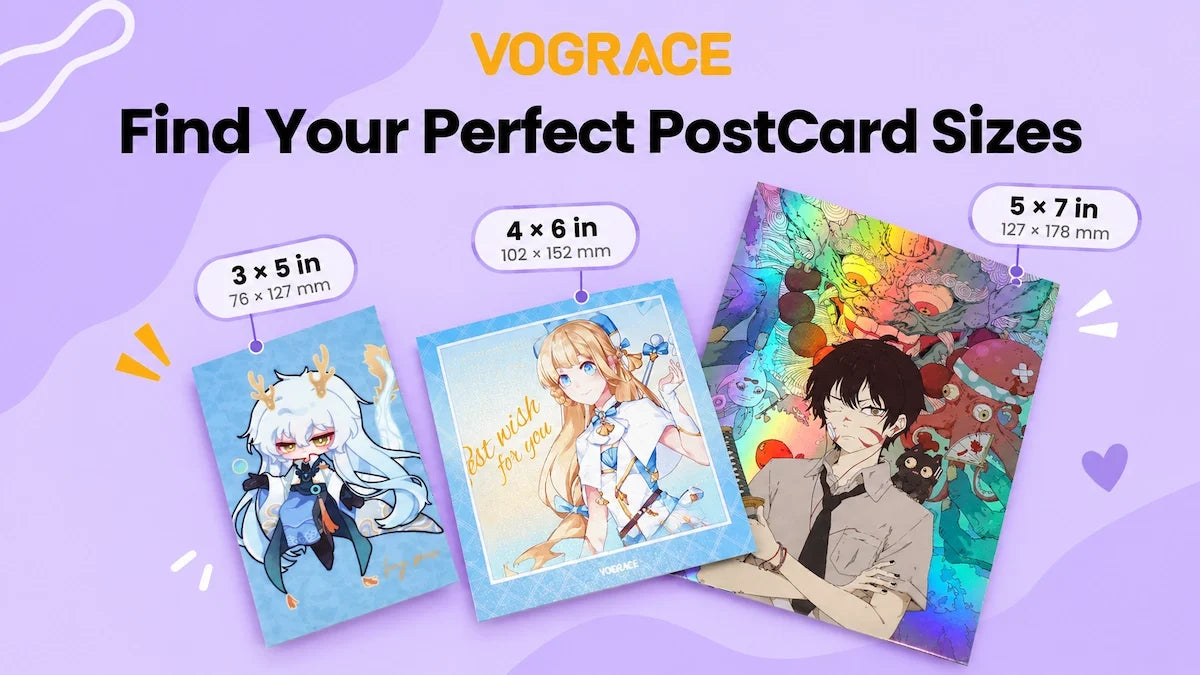
A useful real-world example: Vograce's custom postcards offer 76.2 × 127 mm (3 × 5 in), 102 × 152 mm (approximately 4 × 6 in), and 127 × 178 mm (approximately 5 × 7 in). The smaller option is well suited to package inserts, while the larger two are versatile for illustrations and messages. Vograce's heat-sensitive postcard uses a separate 100 × 150 mm format, so its artwork should be prepared to that exact template rather than a generic 4 × 6 canvas.
USPS Postcard Size and Mailing Requirements
A printing company's “postcard” label and the USPS definition of postcard postage are not interchangeable. This is especially important if you plan to sell a design as a mailed postcard rather than a collectible card.
Minimum and Maximum Sizes for USPS Postcard Rates
For an individual card sent using the USPS retail First-Class Mail postcard rate, the physical limits are:
|
Requirement |
Retail postcard-rate minimum |
Retail postcard-rate maximum |
|
Length |
5 in (127 mm) |
6 in (152.4 mm) |
|
Height |
3.5 in (88.9 mm) |
4.25 in (107.95 mm) |
|
Thickness |
0.007 in (0.178 mm) |
0.016 in (0.406 mm) |
|
Shape |
Rectangular |
Rectangular |
These limits apply to the finished card, not the artwork before trimming. The address must be laid out so the card's longer side serves as the mailpiece length.
A different rule applies to qualifying commercial First-Class Mail postcards prepared under the relevant mailing program. Their maximum dimensions can reach 6 × 9 inches, while the maximum thickness remains 0.016 inch. Commercial postcards exceeding 4.25 inches in height or 6 inches in length generally need to be at least 0.009 inch thick. Commercial rates have mailing-preparation and eligibility conditions; a larger card does not get the commercial postcard rate simply because a business printed it.
Postcard Rate vs. Letter Rate: What Changes with Size?
Here's how common formats compare when sent in the U.S. as individual mailpieces:
|
Finished postcard size |
USPS retail postcard rate? |
Practical note |
|
3 × 5 in |
No |
Too short in height to mail as a bare USPS First-Class card or letter; use a suitable envelope |
|
3.5 × 5 in |
Potentially yes |
Meets minimum dimensions if other card rules are satisfied |
|
4 × 6 in |
Potentially yes |
Common choice for retail postcard postage |
|
A6 (105 × 148 mm) |
Potentially yes |
Dimensions fit, subject to thickness and other rules |
|
4.25 × 6 in |
Potentially yes |
At the retail postcard-rate size limit |
|
5 × 7 in |
No |
Usually letter-rate territory if otherwise eligible |
|
6 × 9 in |
No |
May qualify under eligible commercial postcard mailings; otherwise check letter-rate rules |
|
6 × 11 in |
No |
Oversized promotional piece; postage depends on final mailpiece specifications |
|
5 × 5 in square |
No |
Square pieces can be nonmachinable and cost more to send |
USPS letter-size limits and nonmachinable rules are separate from postcard-rate limits. For example, square letters generally trigger a nonmachinable surcharge. If postage matters to your budget, verify the classification with USPS before printing a large batch.
Postcard Thickness, Shape, and Address Placement
Postal equipment needs cards that are sturdy, readable, and relatively uniform. A few design decisions help avoid problems:
·Leave a clear, high-contrast space for the delivery address and postage. Avoid busy art or metallic effects in that area.
·Place the address parallel to the long side of the card, with the correct orientation for postal processing.
·Check the finished thickness after lamination or special finishes. Paper weight in GSM does not directly tell you whether a card meets USPS thickness limits.
·Avoid attachments, uneven raised elements, rigid constructions, and square layouts when low-cost machinable postage is the priority.
·Use the current USPS template or ask your mailing provider about barcode and address-clearance zones for commercial campaigns.
If your postcards are purely for collecting or packaging, these postal restrictions do not need to dictate the design.
Postcard Size in Pixels and Print Setup
Postcard dimensions are measured in inches or millimeters, but digital artwork needs an adequate pixel count. For sharp printed photos and raster illustrations, 300 PPI at final print size is a dependable working target. Print shops often use “300 DPI” in their instructions, although PPI technically describes image resolution and DPI describes printer output.
Postcard Pixel Dimensions at 300 DPI
The chart below shows pixel dimensions for the finished trim size, before bleed. Values for metric standards are rounded to the nearest pixel.
|
Postcard size |
Pixel dimensions at 300 PPI |
|
3 × 3 in |
900 × 900 px |
|
3 × 4 in |
900 × 1,200 px |
|
3 × 5 in |
900 × 1,500 px |
|
3.5 × 5 in |
1,050 × 1,500 px |
|
4 × 6 in |
1,200 × 1,800 px |
|
100 × 150 mm |
1,181 × 1,772 px |
|
Japanese 100 × 148 mm |
1,181 × 1,748 px |
|
A6 (105 × 148 mm) |
1,240 × 1,748 px |
|
4.25 × 6 in |
1,275 × 1,800 px |
|
5 × 5 in |
1,500 × 1,500 px |
|
5 × 7 in |
1,500 × 2,100 px |
|
5.5 × 8.5 in |
1,650 × 2,550 px |
|
A5 (148 × 210 mm) |
1,748 × 2,480 px |
|
6 × 8 in |
1,800 × 2,400 px |
|
6 × 9 in |
1,800 × 2,700 px |
|
6 × 11 in |
1,800 × 3,300 px |
Formula: width in inches × 300 = width in pixels; height in inches × 300 = height in pixels. For millimeters, multiply each measurement by 300 ÷ 25.4.
These figures are not minimum upload sizes for every printer. Vector artwork can scale without the same pixel constraint, and the printer's supplied template takes precedence. Never enlarge a small image and assume the added pixels restore missing detail.
Bleed, Trim, and Safe Margins
Trim size is the card's finished measurement. Bleed is extra artwork extending past the cut line. A safe area keeps text and important facial details away from the edge.
For example, if a printer requests 0.125 inch (3.175 mm) bleed on every side, a 4 × 6-inch postcard needs a 4.25 × 6.25-inch artwork file, or 1,275 × 1,875 pixels at 300 PPI. Another print shop may request 3 mm bleed, so don't assume the same setup for every product.
Keep backgrounds and borderless illustrations extended to the bleed edge. Put captions, signatures, QR codes, and important character details within the safe area specified in the template. Hairline frames near the cut edge can look uneven even when the trimming tolerance is normal.
For custom printing, start with the exact product template. Vograce's postcard pages request CMYK artwork at 300 resolution, with supported formats including PSD, PNG, PDF, and AI. The selected product template should determine the final canvas, bleed, and any special-effect layers.

Paper Thickness, Finishes, and Print Quality
The right finish depends on how the card will be handled:
·Matte or uncoated surfaces: easier to write on and often more comfortable for address or message areas.
·Glossy surfaces: enhance color contrast and photo-style artwork, but can create glare and make writing harder.
·Holographic or raised-foil accents: effective for collectible character artwork and decorative highlights; check where each effect can be applied.
·Special-effect cards: interactive effects can turn a postcard into merchandise rather than ordinary stationery.
Vograce offers holographic postcards in the same three nominal sizes as its regular postcard product. The effect is intended for the front, not the address side. That makes it a useful choice for art-market collections, but finished thickness and mailability still need checking if you plan to post them without an envelope.
How to Choose the Right Postcard Size
The best size is the one that preserves the artwork and suits what the recipient will actually do with the card. A compact postcard often works better than a large one when it is tucked into a parcel. A detailed scene, on the other hand, benefits from space.
|
Purpose |
Recommended size |
Why it works |
|
Everyday U.S. mailing |
4 × 6 in |
Familiar design area; may qualify for retail postcard postage |
|
Compact mailed note |
3.5 × 5 in |
Smallest eligible retail postcard format, if all requirements are met |
|
General artist merchandise |
4 × 6 or 5 × 7 in |
Easy to display, store, and collect |
|
Detailed illustration or collectible print |
5 × 7 in |
More room for composition and fine details |
|
International-style stationery |
A6 (105 × 148 mm) |
Familiar metric print format |
|
Thank-you card in an order |
3 × 5 or 4 × 6 in |
Fits neatly into many packages |
|
Event invitation or promotional handout |
5 × 7 or 5.5 × 8.5 in |
Extra room for dates, locations, and QR codes |
|
Business direct-mail campaign |
6 × 9 in |
More space for an offer; confirm commercial mailing eligibility |
|
High-visibility marketing piece |
6 × 11 in |
More space for graphics and messaging; not retail postcard-rate size |
|
Character illustration with effects |
4 × 6 or 5 × 7 in |
Collectible scale with room for foil and detail |
For a first artist-market print run, 4 × 6 inches is the most flexible option. Use 5 × 7 for artwork with more detail or when the card is intended to feel like a mini print. A 3 × 5 version makes more sense as an insert than as a standalone mailing piece.
If you're turning original illustrations into merchandise, Vograce offers custom postcard printing with multiple designs, double-sided choices, and material options, with the regular postcard product listed at a minimum order quantity of one piece. You can also choose a distinctive format: its heat-sensitive custom postcards are listed at 100 × 150 mm, with a separate minimum of 30 pieces per design. This makes a sensible option for testing a reveal effect, provided you design from that product's own template.
For any first run, check the dimensions in the final proof before ordering. A good postcard should look right in the hand—not just at 100% zoom on a screen.
Frequently Asked Questions About Postcard Sizes
Is a 4×6 Postcard a Standard Size?
Yes. 4 × 6 inches (about 102 × 152 mm) is the most common U.S. postcard printing format and fits USPS retail postcard-rate dimensions if all other requirements are met.
Is A6 the Same Size as a 4×6 Postcard?
No. A6 is 105 × 148 mm, while 4 × 6 inches is 101.6 × 152.4 mm. They are close, but not interchangeable without adjusting the artwork.
Can You Mail a 5×7 Postcard with a Postcard Stamp?
Not at the USPS retail postcard rate. A 5 × 7-inch card exceeds the size limit and generally needs letter-rate postage if it meets the other mailability rules.
What Size Should a Postcard Be in Pixels?
At 300 PPI, use 1,200 × 1,800 pixels for 4 × 6 inches or 1,500 × 2,100 pixels for 5 × 7 inches, before adding the printer's required bleed.
What Is the Best Postcard Size for Art Prints?
4 × 6 inches is a versatile collectible format; 5 × 7 inches gives detailed illustrations more room. Pick based on the composition and how the print will be displayed.
Can Postcards Be Smaller or Larger Than Standard Sizes?
Yes, for printing, collecting, or handouts. For postal delivery, nonstandard sizes can require different postage or an envelope, and some may not be mailable as bare cards at all.