Plush Size Guide: From Mini to Jumbo, Size Chart & Tips
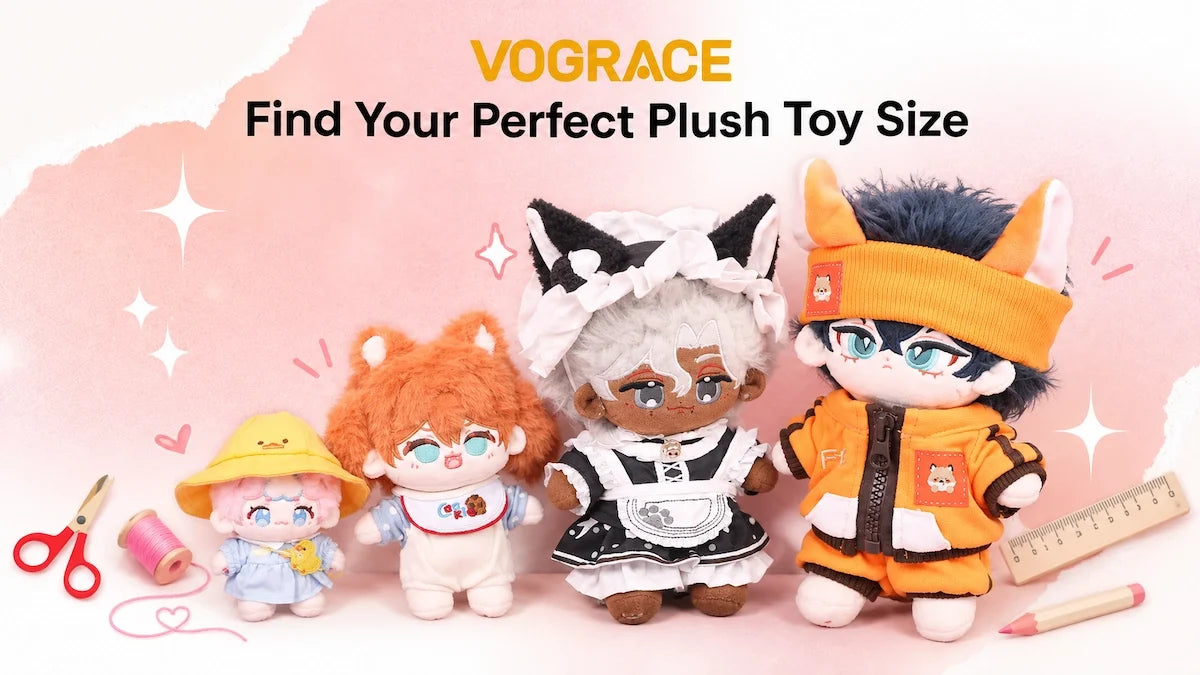
A 12-inch plush might fit neatly on a shelf—or take up half of it. The number alone doesn't tell you whether you're looking at a round, squishy character, a long-limbed doll, or a bear with oversized ears. That is why choosing the right plush size takes more than picking small, medium, or large.
This guide breaks down common plush sizes in inches and centimeters, shows what popular measurements look like, and explains how to measure and choose a plushie for collecting, gifting, cuddling, or display.
Plush Size Chart: Mini to Jumbo at a Glance
There is no universal size chart for plush toys. A 10-inch plush may be called medium at one shop and small at another. The ranges below are a practical way to compare the market, not fixed industry standards. Always check a seller's actual dimensions before ordering.
|
Size category |
Approx. height |
Approx. inches |
Often used for |
|
Micro |
Up to 5 cm |
Up to 2 in |
Tiny charms, miniature collectibles |
|
Mini |
6–10 cm |
2.4–3.9 in |
Bag charms, mini mascots |
|
Small |
11–20 cm |
4.3–7.9 in |
Desk plushies, travel companions |
|
Medium |
21–35 cm |
8.3–13.8 in |
Gifts, shelf displays, cuddling |
|
Large |
36–55 cm |
14.2–21.7 in |
Bedside plushies, room decor |
|
Jumbo / giant |
56 cm and above |
22 in and above |
Oversized gifts, statement pieces |
Size bands are approximate. In this chart, height means the main body’s upright height; a lying plush, round cushion, or long-tailed character may be listed by length or width instead.
If you're comparing listings, the stated measurement matters more than the category name. For example, some retailers reserve “jumbo” for plushies over 30 inches (about 76 cm), while others use it for pieces around 22 inches (about 56 cm).
Plush Sizes Explained: From Mini to Jumbo
Mini Plushies – Tiny and Portable
At roughly 6–10 cm (2.4–3.9 inches), mini plushies are small enough to tuck into a bag, clip onto a backpack, or line up along a desk. Their charm is in the scale: a tiny face, a simple silhouette, and just enough detail to recognize the character. Even smaller micro plushies—around 5 cm (2 inches) or less—are more often treated as miniature collectibles.
A mini isn't necessarily a mini version of a full-size toy. To make the design work, makers often simplify tiny accessories, enlarge embroidered features, or use a compact body shape. Remember to check the total hanging length if a keychain clasp is attached.
Small Plushies – Compact and Cute
Small plush toys fall around 11–20 cm (4.3–7.9 inches) in this guide. Think palm-sized figures, desk companions, and soft toys that are easy to bring along. A plush near 15 cm (5.9 inches) can sit beside a monitor or on a bookcase without taking over the space.
This range offers more room for clothing, facial details, and character-specific features than a tiny charm, while still being easy to display in groups. It can also make a thoughtful small gift when the recipient has limited storage space.

Medium Plushies – Everyday Favorites
Roughly 21–35 cm (8.3–13.8 inches) is a versatile middle ground. A 25 cm plush (9.8 inches) is substantial enough to hold comfortably; a 30 cm plush (11.8 inches) usually reads as a proper stuffed toy rather than a miniature collectible. These are practical sizes for gifts, bedroom shelves, and everyday cuddling.
Medium plushies also tend to leave more room for recognizable proportions, detailed faces, and small outfits. If you're unsure where to begin, comparing a 20 cm and a 30 cm version of the same character is often more helpful than looking at size labels alone.
Large Plushies – Made for Cuddling
At about 36–55 cm (14.2–21.7 inches), a plush becomes more noticeable in both your arms and your room. A 40 cm (15.7-inch) bear can work as a sofa companion, while a 50 cm (19.7-inch) character may take up a significant portion of a chair or shelf.
Check width and depth here, not only height. A broad, round plush at 45 cm can need considerably more space than a narrow doll of the same stated height. Larger toys also vary widely in firmness and weight depending on their stuffing and construction.
Jumbo and Giant Plushies – Big on Comfort
Our reference chart starts the jumbo category at 56 cm (about 22 inches), although some shops don't use the label until 75–80 cm or more. At 60 cm (23.6 inches), a plush is already a prominent room accessory. At 80–100 cm (31.5–39.4 inches), it becomes the sort of oversized companion that may live on a bed, sofa, or floor rather than a display shelf.
Giant plushies make striking gifts and photo props, but measure the space where yours will sit first. Long bodies, wide paws, or oversized heads can change how much floor or furniture space the toy really needs.
Plush Size Comparison: How Big Do Different Sizes Look?
Product photos can distort scale, especially when the plush is photographed alone. The easiest starting point is a real number. The table below converts common inch-based plush sizes to centimeters, with a practical sense of where each might fit.
|
Listed plush size |
Exact metric equivalent |
Quick sense of scale |
|
3 in |
7.6 cm |
Small bag charm or miniature mascot |
|
4 in |
10.2 cm |
Compact, hand-sized mini |
|
5 in |
12.7 cm |
Small desk collectible |
|
6 in |
15.2 cm |
Small handheld plush |
|
8 in |
20.3 cm |
Compact shelf or travel plush |
|
10 in |
25.4 cm |
Medium display or gift size |
|
12 in |
30.5 cm |
Roughly the length of a 12-inch ruler |
|
14 in |
35.6 cm |
Upper-medium to large boundary |
|
16 in |
40.6 cm |
Noticeable sofa or bed companion |
|
18 in |
45.7 cm |
Large cuddle-sized plush |
|
20 in |
50.8 cm |
Large, visually prominent toy |
|
24 in |
61.0 cm |
Oversized, two-foot-long dimension |
|
30 in |
76.2 cm |
Giant plush; measure display space |
|
36 in |
91.4 cm |
Very large room-scale plush |
|
40 in |
101.6 cm |
Just over one meter |
Conversions use 1 inch = 2.54 cm. The final column describes a possible use or visual impression, not the dimensions of every plush design.
Metric listings often use tidy numbers instead: 10 cm ≈ 3.9 in, 15 cm ≈ 5.9 in, 20 cm ≈ 7.9 in, 25 cm ≈ 9.8 in, 30 cm ≈ 11.8 in, 40 cm ≈ 15.7 in, 50 cm ≈ 19.7 in, 60 cm ≈ 23.6 in, 80 cm ≈ 31.5 in, and 100 cm ≈ 39.4 in. That's why a product sold as a “12-inch plush” might be labeled 30 cm on another site: they're close, but not mathematically identical.
For a more reliable visual comparison, look for a photo beside a person, a ruler, or familiar furniture. A front-facing picture is useful, but a side view tells you how much depth the plush has.
How to Measure a Plush Toy Correctly
A plush toy is soft and three-dimensional, so measurements can vary with its pose and how much it is compressed. Use a flat surface, let the toy rest naturally, and record the dimension being measured. Avoid pulling the limbs straight or flattening the stuffing just to reach a particular number.
Standing Height vs. Sitting Height
Standing height is measured vertically from the lowest point of the feet or base to the chosen top point, often the top of the head. Sitting height runs from the surface the toy rests on to that same top point while it is seated. A doll with long legs can have a much shorter seated height than standing height.
For a four-legged or lying character, the most useful dimension may be nose-to-tail length instead of upright height. There is no single measurement convention across sellers, so check whether the listing describes height, length, or the longest overall dimension.
Measuring Width, Depth, Ears and Tails
Width is the toy's side-to-side measurement, usually at its widest body point. Depth is front to back. Ears, horns, tails, hats, and attached accessories can change the total footprint: a bunny with 6 cm ears may stand much taller overall than its body measurement suggests.
For a clear size description, record the following:
1. Body height or length: state the pose and start/end points.
2. Width and depth: measure at the widest natural points without squeezing.
3. Overall size with appendages: specify whether ears, tails, or clothing are included.
4. Keychain hardware: for hanging plushies, list body size and total drop separately where relevant.
A useful listing might read: “Approx. 30 cm (11.8 in) standing height to top of head; 23 cm (9.1 in) wide; ears add 4 cm (1.6 in).” It tells you much more than “medium plush.”
Why Plushies of the Same Size Can Look Different
Two toys can both be labeled 20 inches and still feel completely different. A few design choices explain most of the difference:
·Shape and proportions. A round cat plush fills more space than a slim, long-legged doll at the same height.
·Pose and measurement direction. A 20-inch lying animal may be 20 inches from nose to tail, while a sitting bear is measured vertically.
·Stuffing and firmness. Firm filling holds a fuller shape; softer filling settles or spreads when the plush rests on a surface.
·Fur and accessories. Long pile fabric, large ears, wings, or clothing can make the outline seem bigger without changing the main body measurement.
The best product listings pair dimensions with more than one photograph. For unusually shaped plushies, a simple height × width × depth measurement is far more revealing than a size label alone.
How to Choose the Right Plush Size
Start with where the plush will spend most of its time. Something meant for a backpack has different needs from a toy intended to fill the corner of a couch.
For Keychains, Collections and Display
For bag charms or tiny mascots, consider roughly 6–15 cm (2.4–5.9 inches), depending on the design and hardware. For a crowded shelf, 10–20 cm figures are easier to arrange in rows. Collectors may prefer several smaller characters rather than one large piece, especially when building a coordinated set.
Look beyond height: a wide tail, large hat, or long keychain attachment can interfere with how the toy hangs or stands.
For Gifts and Everyday Cuddling
For a general-purpose soft toy, roughly 20–35 cm (7.9–13.8 inches) is a useful size range to explore. It's large enough to feel substantial without being cumbersome to carry around. A 40–50 cm plush can offer a more generous cuddle, provided the recipient has somewhere to keep it.
For children's toys, suitability is not determined by size alone. Follow the manufacturer's age guidance and check seams, attachments, and small parts. In particular, keep stuffed animals and other soft objects out of an infant's sleep space. The U.S. Consumer Product Safety Commission provides general toy-safety guidance.
For Room Decor and Oversized Plushies
A 35–55 cm plush works well as a visible bed or sofa accent; larger designs around 60–100 cm are statement pieces. Before buying a giant plush, measure the intended spot and remember that width and depth matter just as much as length.
For easy comparison, place a ruler or measuring tape on your sofa, bed, or shelf to mark the listed dimension. It's a simple check that prevents the classic “much bigger than I imagined” surprise.
Choosing the Right Size for Custom Plushies

When a plush starts as your own character artwork, size affects more than where it will sit. At a tiny scale, delicate expressions, layered hair, clothing details, and narrow limbs may need to be simplified. A larger version gives those features more room, but the pattern and proportions still need to be designed for that scale—not merely enlarged.
Vograce's custom plush dolls include a 10 cm option, while its round custom Manjuu plush is listed at 7.5 cm in diameter. Those two examples show why shape and measurement direction matter as much as a single number. Available sizes and design requirements differ by product, so check the specific page before planning artwork.
A good starting point is to print your character at its intended finished height, place it where the plush will live, and see which details remain readable. The right custom plush size is the one that suits both the design and the way it'll be used.
FAQs About Plush Sizes
Is a 12-Inch Plushie Considered Medium?
Often, yes. 12 inches equals 30.48 cm, which falls into the medium range in this guide. Other retailers may classify it differently.
How Big Is a 20-Inch Plushie?
20 inches is 50.8 cm—a little over half a meter. That's generally a large plush, but check whether the figure refers to height or length.
Are Plush Sizes the Same Across Different Brands?
No. Mini, small, medium, large, and jumbo are flexible retail labels. Compare the actual measurements in inches or centimeters instead.
What Is the Difference Between Jumbo and Giant Plushies?
There is no fixed cutoff. Both describe oversized plush toys, and some brands use the terms interchangeably. Always check the stated dimensions.
Does Plush Size Include the Ears or Tail?
Not always. Some sellers measure the body, others include protruding parts. Check the measurement notes or ask for the overall height, width, and depth.
What Plush Size Is Best for a Desk?
A plush around 10–20 cm (3.9–7.9 inches) is often convenient for a desk. Narrow shapes take less room than round or wide ones of the same height.
The takeaway: use size labels as a starting point, then rely on the measurements. A clear size chart, a photo showing scale, and an understanding of the plush's shape will help you find the right fit—from a miniature mascot to a giant cuddle companion.