Is Print on Demand Worth It for Fan Artists? Pros, Cons & How It Works
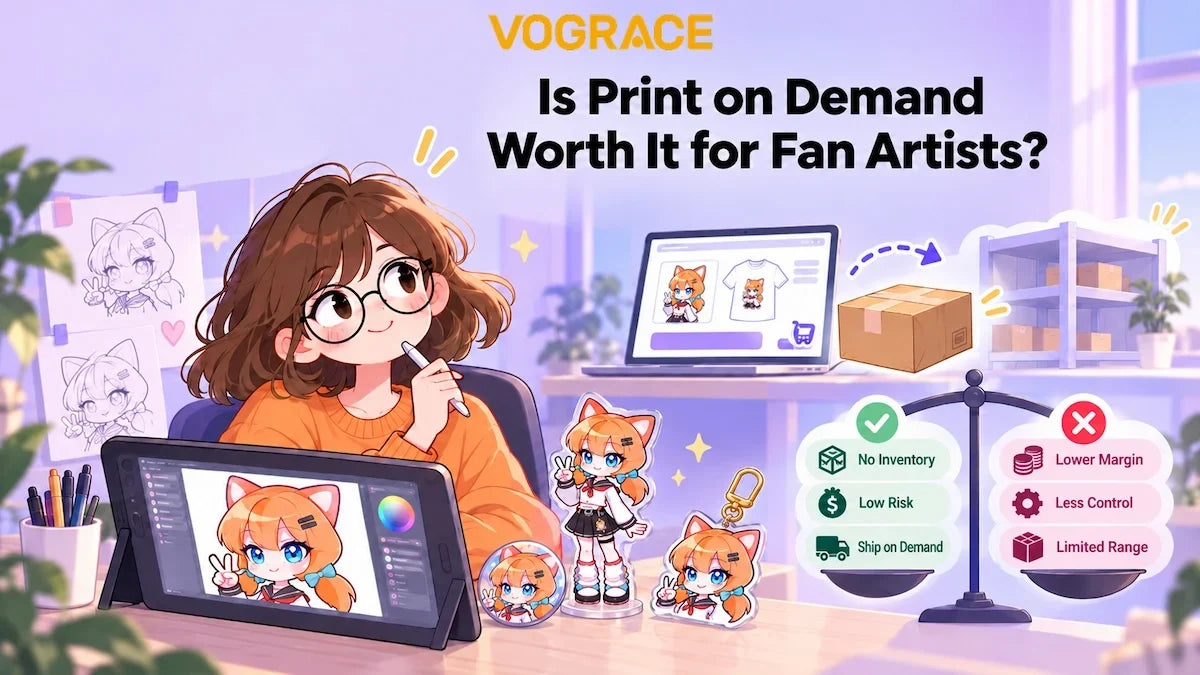
For fan artists, independent illustrators, and small creators making merch for the first time, print on demand (POD) can sound almost too good to be true.
You create the artwork, upload your designs, choose the products, and promote your store. When a customer places an order, the production partner takes care of manufacturing, packing, and shipping.
No need to order 50 or 100 pieces upfront. No boxes of unsold keychains taking over your room. No daily trips to the post office.
That convenience is exactly why POD has become such an appealing way for artists to start selling physical merchandise.
But there is an important catch:
No inventory does not mean no costs, and no production work does not mean no business work.
So, is print on demand actually a good choice for fan artists?
For many creators, yes—but not in every situation. The right choice depends on your audience size, product ideas, expected sales, profit goals, and where you are in your journey as an artist.
Here is what you should know before choosing POD for your merch business.
What Does Print on Demand Mean for Fan Artists?
POD stands for print on demand. The basic idea is simple:
A product is made only after someone orders it.
Instead of paying for a large production run in advance, you can sell individual products as orders come in.
POD is already common for products such as T-shirts, posters, wall art, and phone cases. For anime, fandom, and artist merchandise, however, the model can look a little different.
Creators often want products such as:
• Acrylic keychains
• Acrylic standees
• Pins and badges
• Holographic cards
• Stickers
• Tote bags
Not every type of artist merch is naturally suited to on-demand production. Flexible manufacturing and small-batch production, however, make it possible to bring more of these products into a POD workflow.
Through platforms such as Artiststore, creators can upload their artwork and sell merchandise without holding stock or handling fulfillment themselves. Orders can be produced and shipped directly to customers around the world.
In practical terms, the model usually works like this:
• You create and upload the artwork.
• The platform displays the products and processes orders.
• The production partner manufactures and ships them.
• Customer service and fulfillment are handled for you.
• You earn a share of each sale or the profit you set.
Instead of spending most of your time thinking about inventory, packaging, and logistics, you can focus on two things that matter much more:
creating work people want and helping the right audience discover it.
Is POD a Good Choice for Fan Artists?
For creators making merch for the first time, POD can be one of the easiest ways to test the waters.
It is especially useful if you:
• Have a relatively small or developing audience
• Do not want to invest heavily in inventory
• Have limited experience with fulfillment
• Want to test several designs before producing in bulk
• Are unsure which products your audience will actually buy
It allows you to build a simple commercial loop—create, list, sell, and learn—without taking on a large amount of inventory risk.
However, POD is not automatically the best solution forever.
If you already have a loyal audience, know that a particular design is likely to sell well, want stronger control over packaging and presentation, or are aiming for higher margins, small-batch or bulk custom manufacturing may make more sense.
A useful way to think about the two models is:
POD helps solve the “0 to 1” problem.
It lets you start with less risk.
Batch production helps with the “1 to 10” problem.
Once you know what sells, larger production runs can improve margins and give you more control over the finished product.
For many artists, the strongest long-term approach is not choosing one or the other. It is learning how to use both.
5 Benefits of Selling Merch Without Inventory
1. Much Lower Upfront Risk
Traditional merch production usually follows the same pattern:
Pay first → manufacture products → hope they sell.
That means you may need to invest money before you know whether customers actually want your design.
With POD, production begins only after an order is placed.
This can be particularly valuable for students, hobby artists, part-time creators, or anyone whose income from art is still unpredictable.
Imagine uploading three designs and offering each one as a sticker, acrylic keychain, and pin.
With traditional production, you might need to manufacture dozens of each variation before selling a single item.
With POD, you can simply upload the artwork, prepare the product previews, and publish the listings. If a customer in the United States buys a keychain and another customer in Japan orders a sticker, those individual products can be produced and fulfilled without you stocking an entire batch first.
That makes experimenting far less intimidating.
2. A Natural Fit for Niche and Long-Tail Audiences
Fan artists rarely create for everyone.
Your audience may be built around one fandom, one character, one pairing, one original character, or a very specific art style.
These communities may not always be huge, but they can be highly engaged.
That is where POD becomes particularly useful.
A design that sells only ten copies may not justify a traditional production run. With an on-demand model, however, ten individual orders can still be produced and shipped.
You do not necessarily need thousands of followers before trying to sell merch.
Even a small community of people who genuinely enjoy your work can be enough to start learning what your audience wants.
3. Less Time Spent Packing and Shipping
Many artists underestimate how much work begins after a product sells.
Someone still needs to:
• Sort the products
• Buy packaging materials
• Pack every order
• Print shipping labels
• Arrange delivery
• Track parcels
• Handle damaged or missing shipments
• Respond to customer questions
Doing this yourself may be manageable for a handful of orders. It becomes much harder when you are also working on commissions, preparing new artwork, posting on social media, or getting ready for a convention.
With a POD setup, much of that operational work is handled by the platform and production partner.
For many creators, this is one of the biggest advantages of the model: selling merch without turning yourself into a full-time fulfillment team.
4. Easier and Cheaper Product Testing
POD also gives you room to experiment.
Instead of committing to one design and one product, you can test several combinations at once.
For example:
• Which characters get the strongest response?
• Which compositions work best as acrylic keychains?
• Do your followers prefer stickers or standees?
• Which designs receive repeat orders?
• Which products perform better in different markets?
Real sales data can then help guide future production decisions.
If one acrylic keychain consistently sells better than your other designs, that information may justify producing a larger batch later.
POD data is not a perfect prediction of how a product will perform at scale. Traffic, promotion, pricing, and audience growth can all change the outcome.
But it still gives you something much more useful than guessing:
real buying behavior.
5. Your Older Artwork Can Keep Selling
A POD listing does not disappear simply because the launch week is over.
As long as the product remains available, older designs can continue generating occasional orders.
An illustration you uploaded six months ago might suddenly be discovered by a new follower. An older fandom design could attract attention again after renewed interest in the series.
That gives your existing art library more opportunities to keep working for you.
It is not completely “passive income”—you still need to maintain your store and bring in traffic—but POD can make older artwork easier to monetize over a much longer period.
The Downsides of Print on Demand
POD removes several barriers, but it also creates trade-offs.
Understanding them before opening your store will help you decide which products belong in your POD catalog and which ones may be better suited to custom production.
1. Lower Profit Per Item
POD platforms and production partners handle manufacturing, fulfillment, shipping processes, and other operational work.
Those services have a cost.
As a result, your margin on each product may be lower than it would be if you ordered a larger quantity directly from a manufacturer.
This becomes especially noticeable when your audience has a fairly fixed idea of what they are willing to pay for a sticker, keychain, or pin.
There is only so far you can raise the retail price before the product becomes difficult to sell.
For this reason, POD is often strongest when the goal is low-risk selling and testing, rather than maximizing the profit on every individual unit.
2. Less Control Over the Full Brand Experience
One of the joys of selling merch yourself is being able to add personal details.
You might want to include:
• Custom backing cards
• Numbered limited editions
• Handwritten thank-you notes
• Special packaging
• Signed items
• Convention-exclusive bonuses
These details can make fans feel more connected to both the artwork and the artist.
A standardized POD fulfillment process gives you less room to customize every part of that experience.
For casual or long-tail products, that may not matter very much.
For limited editions, collector products, or merchandise closely tied to your personal brand, however, direct or batch production may give you more creative control.
3. Some Products and Techniques Are Harder to Produce On Demand
POD has become much more flexible, but not every merch idea works equally well with the model.
Products involving unusual structures, special materials, complex assembly, or highly specialized finishing may still require custom production.
Examples may include:
• Multi-layer acrylic standees
• Standees with unusual bases or supporting structures
• Highly complex custom-shaped products
• Plush, enamel, or etched-metal merchandise
• Products requiring significant manual assembly
• Specialized foil, UV, or decorative finishing
When production becomes highly customized, manufacturing one item at a time may either be impractical or considerably more expensive.
This is one reason experienced creators often use POD for part of their catalog rather than everything they sell.
POD vs. Batch Production: Why You May Want Both
For many artists, the most practical strategy looks like this:
Test with POD first, then move proven products into small-batch production.
That approach keeps the early stages flexible while giving successful products room to grow.
Stage 1: Test With POD
During your first few months, start small.
Upload around three to five designs across several relevant product types.
Promote them naturally through your social channels, communities, or existing audience.
At this stage, you do not need a viral launch.
You are mainly looking for signals:
Which designs generate real orders? Which products get positive feedback? What are people willing to pay for?
Stage 2: Review the Data
Once you have enough orders to see patterns, look more closely at the results.
Ask:
• Which designs sold the most?
• Which product categories performed best?
• Where did most orders come from?
• Which designs were mentioned repeatedly by followers?
• Which products attracted repeat purchases?
From there, choose one or two designs that appear to have stronger potential.
Stage 3: Move Proven Products Into Small-Batch Production
Once a product has demonstrated demand, you can consider producing a small batch.
This can help you:
• Reduce unit costs
• Increase margins
• Improve packaging
• Prepare inventory for conventions
• Offer special editions
• Add bonus items or collector extras
Most importantly, you are no longer placing the order based purely on intuition.
You already have sales data supporting the decision.
Stage 4: Run Both Models Together
Eventually, your merch catalog could use two different systems.
Keep POD for niche designs, older artwork, and products with unpredictable demand.
Use batch production for your strongest sellers, convention inventory, premium releases, and products that benefit from more customization.
This creates a much more flexible business:
POD handles the long tail, while batch production supports your proven products.
How Artiststore Helps Artists Get Started With POD

Vograce has built its business around custom anime, fandom, and artist merchandise, serving more than 200,000 creators worldwide.
That experience with products such as acrylic merchandise, pins, stickers, cards, and other creator-focused items is also part of the idea behind Artiststore, a POD selling platform designed for independent artists.
Instead of asking artists to manage manufacturing and fulfillment themselves, Artiststore connects the storefront and production process.
How Artiststore Works
The basic workflow is straightforward.
1. Upload your designs
Add your original illustrations, OC artwork, fan art, or other designs to Artiststore.
2. Turn your artwork into merchandise
Your designs can be prepared for products such as acrylic keychains, standees, pins, stickers, cards, tote bags, and more.
3. Set up your products and pricing
Choose what you want to sell, prepare the listings, and set your pricing according to the platform's available options.
4. Customers place their orders
Once someone buys your product, Vograce handles on-demand production and international fulfillment. You do not need to keep stock, pack individual parcels, or manage the production process yourself.
5. Earn from each sale
As orders come in, your store can continue generating revenue from the products you have already created.
From POD to Custom Production
POD does not have to be the final step.
If one of your Artiststore products starts performing consistently, you can move that design into Vograce's small-batch custom manufacturing process.
That can be useful for convention stock, group orders, independent stores, premium packaging, or larger releases.
In other words:
Use POD to discover what people want. Then use custom production when you are ready to scale it.
The two models do not need to compete with each other.
They can be different tools for different stages of the same creator business.
Final Thoughts: POD Is a Starting Strategy, Not a Compromise
So, is print on demand good for fan artists?
For creators who are just beginning to sell physical merchandise, it can be a particularly practical starting point.
You can launch with less inventory risk, test several ideas, avoid handling every shipment yourself, and learn what your audience is genuinely willing to buy.
The trade-offs are equally real.
Margins can be lower. Your control over packaging and presentation may be more limited. Some highly customized products simply work better with batch manufacturing.
That is why POD does not need to replace traditional merch production.
A more flexible approach is to use POD for testing, niche products, and long-tail sales, then move your strongest products into small-batch production when the demand is there.
For fan artists, the real goal is not simply to “make some merch.”
It is to build a system that allows your artwork to reach fans without creating more inventory, logistics, and financial pressure than you are ready to handle.
POD can be a very effective first step toward doing exactly that.