How to Choose Your First Merch: A Low-Risk Guide for Artists
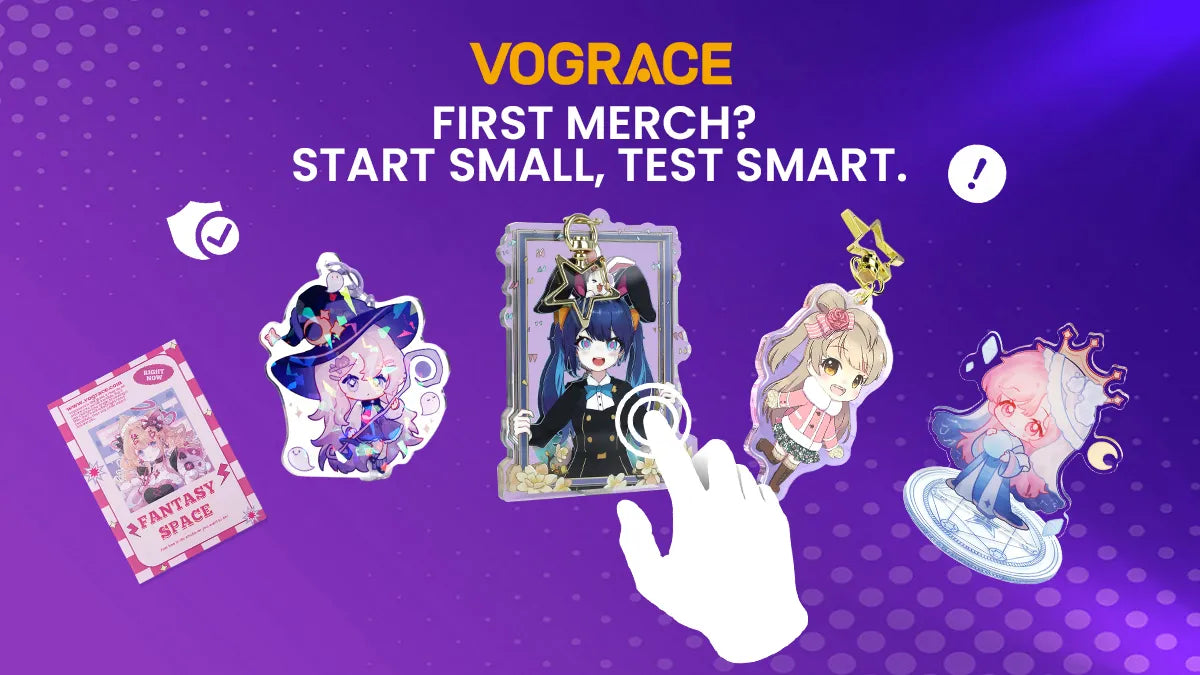
If you’re an independent artist, fan artist, or small creator with anywhere from a few hundred to a few thousand followers, choosing your first piece of merch can feel surprisingly difficult.
The goal isn’t to guess what will become a bestseller. It’s to find a product your audience actually wants—without tying up too much money in inventory.
This guide gives you a simple, repeatable way to test merch ideas before committing to a larger production run.
Your First Merch Shouldn’t Become Your Biggest Regret
Most artists have heard a story like this.
Someone sees acrylic standees selling out at the booth next door, orders 200 of their own, and six months later has sold only 23.
Another creator spends weeks designing an adorable plush, only to discover that 10 people out of 500 followers are actually ready to buy it. Now half the room is filled with unsold plushies.
And plenty of artists never launch anything at all—not because they don’t want to, but because they don’t know what to make and they’re afraid of losing money.
The problem usually isn’t that the artwork isn’t good enough.
The problem is committing too much money, time, and energy before you have enough information.
There is no product that is guaranteed to sell. What you can do is reduce the guesswork.
A practical low-risk merch test looks like this:
Understand your audience and artwork → rank products by risk → test demand in stages → use real results to decide what to make next.
Step 1: Start With Three Simple Profiles
Before comparing prices or requesting samples, narrow down what is actually worth testing.
You can do that by looking at three things: your art style, your audience, and the type of content people already respond to.
1. Which Products Fit Your Art Style?
The same illustration can feel completely different depending on how it is turned into a physical product.
That’s why your art style should be one of your first filters.
|
Art Style |
Merch Worth Testing |
|
Detailed line art, pencil work, black and white |
Postcards, shikishi boards, stickers |
|
Painterly art, rich lighting and shading |
Acrylic standees, button pins, acrylic charms |
|
Cel-shaded, clean or flat-color artwork |
Stickers, button pins, small acrylic charms |
|
Cute, chibi or soft character styles |
Button pins, mini charms, plushies |
|
Atmospheric or illustration-focused artwork |
Shikishi boards, postcards |
The basic rule is simple:
Choose a product that shows your artwork at its best, not one that forces it into a format where its strongest details get lost.
A beautifully rendered full-body character, for example, may work naturally as an acrylic standee. A small expressive illustration might make much more sense as a sticker or button pin.
You don’t have to follow these pairings exactly, but they’re a useful place to start.
2. Why Do People Follow You?
People don’t always follow an artist for the same reason—and that reason often affects what they’re willing to buy.
If your audience follows you for your characters or stories, character-focused merch such as acrylic standees, charms, and button pins may have the strongest appeal. They’re buying because they feel attached to the character.
If they follow you primarily for your visual style, art-focused products such as postcards, shikishi boards, or fine art prints may make more sense. In this case, the artwork itself is the product.
If people enjoy your personality and everyday content, lifestyle merch such as stickers, tote bags, or phone cases can bring a little piece of your work into their daily routine.
And if your followers are especially interested in how you create, sketchbooks, concept collections, or behind-the-scenes art books may feel more collectible.
It’s also worth thinking about buying power.
Is most of your audience made up of students looking for affordable collectibles, or working adults who may be comfortable spending more on premium pieces?
Audience behavior can also vary between markets. Fans in Japan, for example, may already be very familiar with character merchandise and collecting culture, while audiences in Europe and North America may place more emphasis on originality, supporting individual creators, and the overall unboxing experience.
The important thing is not to rely on stereotypes, but to recognize that different audiences may give you different buying signals.
3. Do You Have One Standout Character—or a Broader Style?
Take a look at the content that consistently performs best.
If one character, series, or original IP already receives noticeably more attention than everything else, start there. Demand is more concentrated, which makes character-focused merch easier to test.
If your work is more varied and there isn’t one obvious favorite, test whether people are willing to buy into your style itself.
That might mean starting with non-character stickers, abstract artwork, postcards, or other designs that don’t depend on a single IP.
By this point, you should have a shortlist of products that make sense for both your artwork and your audience.
Now you can start thinking about risk.
Step 2: Rank Your Merch Ideas by Risk
Not every product makes sense as a first launch.
Two factors matter most:
Production cost — including unit price and minimum order quantity.
Demand confidence — how much evidence you already have that people want the product.
Using those two factors, you can roughly divide merch ideas into three groups.
Low Risk: The Best Place to Start
Think:
Stickers, postcards, shikishi boards, button pins, and small acrylic charms.
These products generally have relatively accessible production costs, can often be ordered in smaller quantities, and are already familiar to most merch buyers.
If your prediction is wrong, the downside is usually easier to manage.
That makes them excellent testing products for a first merch launch.
Medium Risk: Affordable, but Less Predictable
This category can include products such as:
Clear cards, holographic tickets, and metal bookmarks.
Production itself may still be affordable, but customer demand can be harder to predict.
A fan might love the artwork but hesitate because they’ve never bought that type of product before or aren’t sure what they would do with it.
These products often make more sense after you’ve already received positive signals from a simpler first launch.
High Risk: Save These for Later
Plushies, large acrylic displays, full merch sets, and PVC bags can be exciting—but they also require more commitment.
Higher unit costs, longer production timelines, and larger total orders mean unsold inventory hurts much more.
That doesn’t mean you should never make them.
It simply means they’re better suited to a stage where you’ve already tested your audience and have stronger evidence that the demand is there.
Step 3: Test Demand Before You Commit
You don’t need to jump straight from “I have an idea” to “I ordered 200 pieces.”
Instead, test the idea in stages.
Each stage costs a little more, but it also gives you a stronger signal.
Stage 1: Zero-Cost Demand Testing
Before paying for production, take the idea to the platforms where your audience already follows you.
There are three easy ways to start:
1. Post a concept and ask directly.
Show the design as a mockup and ask whether people would actually want it as merch.
2. Run a multiple-choice poll.
Instead of asking “Do you like this?”, compare real options: sticker, acrylic charm, button pin, standee, and so on.
3. Ask your core community separately.
Your most active Discord members, Patreon supporters, regular customers, or long-time followers can often give more thoughtful feedback than a public poll.
At this stage, you’re looking for patterns rather than compliments.
“That’s cute!” is encouraging.
“I would buy the 70 mm acrylic standee” is much more useful.
Stage 2: Run a Small Preorder Test
This is one of the most useful stages because the signal becomes much harder to fake:
people are willing to spend money.
Likes, comments, and poll votes are helpful, but a preorder tells you that someone is actually ready to buy the product.
You can keep this test simple:
1. Announce the planned product and preorder period.
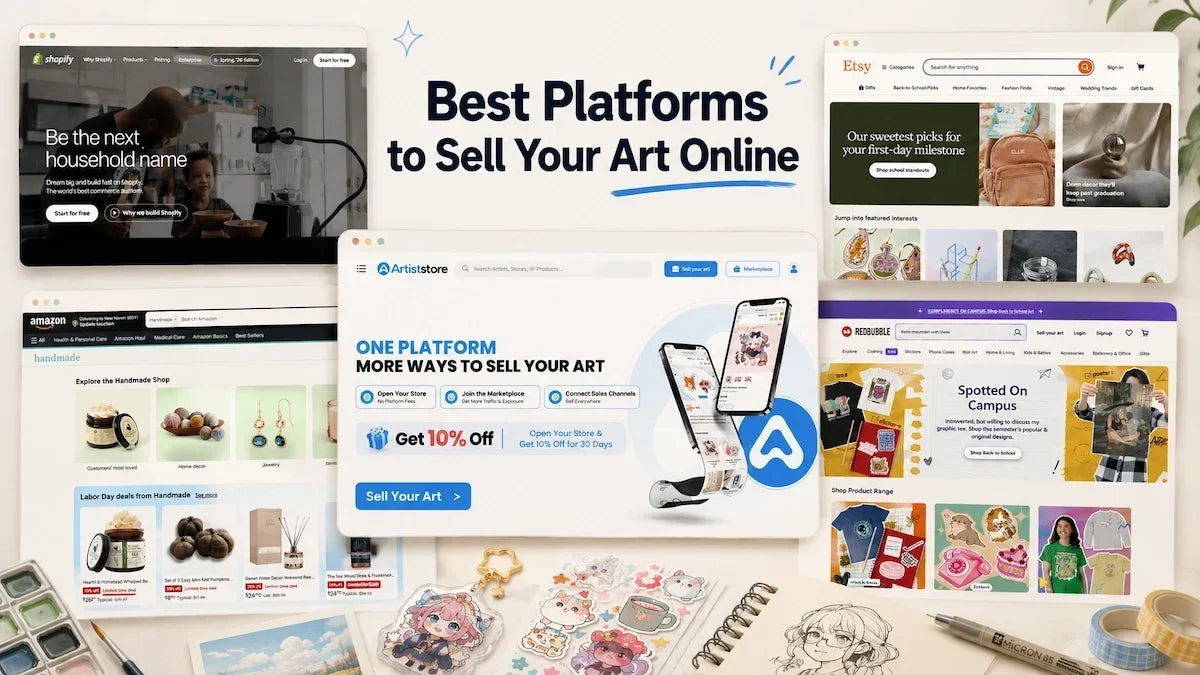
2. Use a preorder or creator storefront platform, such as ArtistStore, to collect orders.
3. Set a minimum production target before moving forward.
This approach can help you avoid producing a large batch based entirely on social engagement.
If the preorder target isn’t reached, you’ve learned something useful without being left with boxes of unsold inventory.
Stage 3: Validate With a Small Production Run
Once the product has shown enough interest, you can move to actual production—but there’s still no reason to go big immediately.
Start with the smallest quantity that makes sense.
Then:
1. Place a small production order.
2. Launch it while audience interest is still fresh.
3. Review what happened after the sale.
How quickly did it sell? Which designs performed better? What questions did customers ask? Would buyers purchase another variation?
Use those results to decide whether the product deserves a larger restock, needs to be adjusted, or simply isn’t the right direction yet.
That decision is much easier when it comes from real customer behavior instead of guesswork.
You Don’t Need a Bestseller on Your First Try
Your first merch launch doesn’t have to prove that you’ve “made it.”
It only needs to teach you something.
A small sticker run that sells steadily can give you more useful information than an ambitious product that leaves you with hundreds of unsold units.
Start with a format that suits your artwork. Listen to the audience you already have. Test interest before committing. Then increase production only when the signals become stronger.
The goal isn’t to avoid every failed product.
It’s to make sure one wrong guess doesn’t stop you from making the next one.
About Vograce
Vograce helps independent artists and creators turn their artwork into custom merch without requiring a huge first production run.
Products such as custom acrylic standees, button pins, stickers, shikishi boards, and other artist merch are available with low minimum order quantities, making it easier to test an idea before scaling up.
Used alongside the testing process above, small-batch production can take you from a rough concept to a real product without forcing you to make a large inventory bet from day one.
Creators can also use ArtistStore, Vograce’s creator storefront platform, to build their own merch shop, manage orders, set preorder targets, and stay connected with fans—without having to build an ecommerce website from scratch.
Low-MOQ custom merch: vograce.com
Creator storefronts: artiststore.com